

I have spent most of my adult life in rooms full of stressed people, and I learned one thing early: sometimes a person settles faster when their hands have something to do. So when I decided to try a kalimba, I did not want a complicated instrument. I am 57, I have no formal training, and I played piano badly as a kid. I wanted something quiet, simple, and forgiving. The Newlam 17-key kalimba is the one that ended up in my sunroom, and after weeks of playing it for about ten minutes most mornings with coffee and again at night before bed, I have a clear picture of what it does well and where it asks for patience.
This is a review for other adults like me: people who are not musicians, who do not want to read sheet music, and who just want a calm hands-on instrument that sounds pretty without demanding hours of practice. The Newlam kalimba is a 17-key thumb piano in C tuning, made of wood with spring steel tines, and it weighs 11.52 ounces. I ordered one, played my first recognizable tune within an hour, and kept going long enough to know its habits.
The Quick Verdict
The Newlam 17-key kalimba is the rare instrument that actually delivers on the promise of playing in minutes, and it still has enough range to keep a beginner interested for months. It is not a toy, but it is also not a serious performance instrument, and that is exactly why I reach for it every day.
Amazon Check Today's Price →Want a calm instrument you can actually play tonight?
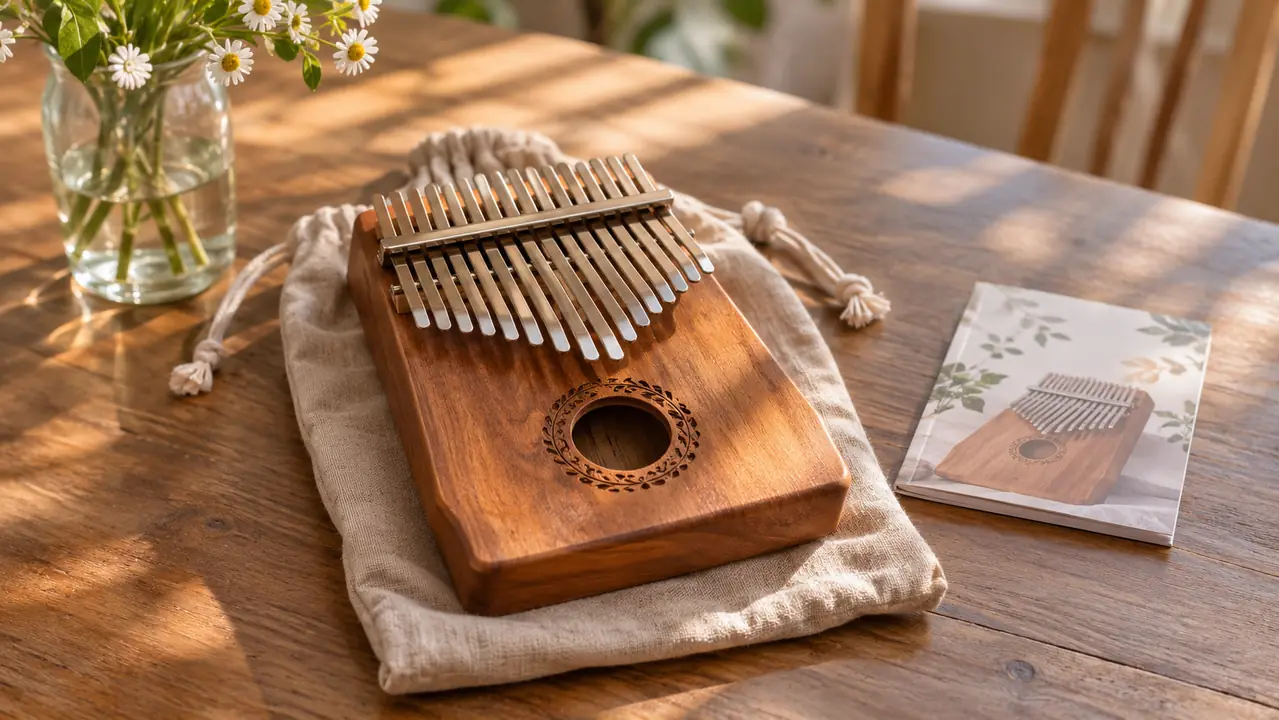
The Newlam 17-key kalimba comes with everything you need to start: an instruction book, a flannelette bag, and a cleaning fabric. No experience required, no tuning knowledge needed out of the box. If you have been looking for a quiet hands-on instrument, this is the one I kept reaching for.
Amazon Check Today's Price on Amazon →How I've Used It
My routine is simple. Most mornings I make coffee, sit in the sunroom, and play for about ten minutes. At night I do the same thing before bed. That is roughly 20 minutes a day, and it has been consistent for weeks. I am not trying to learn songs quickly. I am trying to give my hands and my head something calm to do, and the kalimba fits that role better than anything else I own.
The first thing I noticed is that the keys are engraved with letters and musical notes, which sounds like a small thing until you are staring at an instrument you have never touched. I did not have to count keys or memorize anything. I looked at the note name, pressed the tine, and heard what I expected. The instruction book that comes in the box walks through the basics in plain language, and the included flannelette bag gives it a safe home when I am done.
I have left it on the kitchen table, on the sunroom sill, and once on the arm of the couch. The wood is sturdy and the 11.52 ounce weight means it is easy to carry from room to room without thinking about it. The 7.08 x 5.08 x 1.18 inch dimensions make it comfortable to hold in my lap or rest on a table. It is not a fragile ornament. It is a working instrument that happens to look nice sitting out.

What's in the Box
The Newlam kalimba arrives as a complete kit, which matters more than it sounds like it should. Along with the thumb piano itself, you get an instruction book, a flannelette bag, and a cleaning fabric. I have bought instruments before that required a separate trip for accessories. This one was ready to play the moment I opened the box.
The flannelette bag is not a throwaway. It is soft, roomy, and lined well enough that I trust it to protect the wood when the kalimba sits in a drawer or goes in a bag for a visit to my daughter's house. The cleaning fabric lives in the bag too, so I never have to hunt for it. Small details like that are why I stopped looking at other kalimbas.
What the Newlam Kalimba Gets Right
The sound is the first thing people ask about, and the Newlam delivers exactly what the listing promises: a rich, ethereal timbre. The 17 keys in C tuning cover a little more than two octaves, which is enough for a surprising number of familiar melodies. I learned 'Twinkle, Twinkle' within the first hour, and by the end of the first week I could play several simple folk tunes without looking at the engraved notes.
What surprised me is how forgiving the instrument is. On a piano, a wrong note is loud and obvious. On this kalimba, a slightly off thumb placement just makes a softer sound. There is no harsh attack, no jarring mistake. That forgiving quality matters more than I expected, because it means I never feel punished for not knowing what I am doing. I can play slowly, make a mistake, and just keep going.
The build quality is also better than I expected. The naturally air-dried wood feels solid in my hands, and the spring steel tines have held their tuning well over weeks of daily use. I have not needed to tune it once since it arrived. The 180 day warranty is a quiet reassurance that the company expects the instrument to last, and so far it has.
What Nobody Tells You Before You Buy
Here is the honest part. The kalimba is quiet, and that is both its greatest strength and its main limitation. When I play in the sunroom, my husband Walt, who claims he is tone deaf, can barely hear it from the next room. If you want an instrument that fills a room with sound, this is not it. If you want something you can play while someone else reads in the same room, this is exactly it.
The second thing nobody tells you is that your thumbs get tired at first. The tines are spring steel, and pressing them repeatedly uses small muscles that most of us never exercise. For the first week, my thumbs ached after ten minutes. That faded quickly, and now I can play for much longer without discomfort. It is not a reason to skip the instrument, but it is a reason to start with short sessions.
The third thing is that the included instruction book is friendly but basic. It gets you playing quickly, which is exactly what a beginner needs, but it will not teach you advanced technique. If you fall in love with the instrument, you will eventually want to find more resources online. For the first few weeks, though, the book is plenty.
How It Compares to the Alternatives I Considered
Before I settled on the Newlam, I looked at a few other options. I considered a small tongue drum, which has a deeper, more resonant sound, and I considered a simpler 8-key kalimba. The tongue drum sounded lovely, but it was heavier and louder than I wanted for a sunroom instrument. The 8-key version was simpler, but the limited range meant I would outgrow it quickly. The Newlam 17-key sat in the middle, and for my purposes that middle ground was exactly right.
I also thought about whether I wanted an instrument with more keys. Some kalimbas go up to 21 keys, and they can play a wider range of music. But more keys also means a larger, heavier instrument, and the whole point for me was something small and unobtrusive. The 17-key layout covers the folk tunes and hymns I actually want to play, and the 7.08 x 5.08 x 1.18 inch size means it disappears into a bag when I need it to.
The comparison that matters most, though, is the one I cannot put in a table. The Newlam is the instrument I actually play. The tongue drum sits in the corner and comes out once a week. The kalimba comes out twice a day. There is something about the immediate response of the tines, the way a single thumb press produces a clear note with no fuss, that makes it the easiest instrument in my house to reach for.
What I Liked
- Ready to play out of the box with engraved letters and notes on every key
- Rich, ethereal timbre from 17 keys in C tuning, enough range for folk tunes and hymns
- Sturdy wood build with spring steel tines that have held tuning for weeks
- Complete kit includes instruction book, flannelette bag, and cleaning fabric
- Quiet enough for a shared room, light enough at 11.52 ounces to carry anywhere
Where It Falls Short
- Quiet by design, so it will not fill a room or carry over conversation
- Thumbs can ache during the first week while small muscles adjust
- Two octaves of C tuning will feel limiting if you want complex music
- Instruction book is friendly but basic, so advanced players will need outside resources
The kalimba is quiet, and that is both its greatest strength and its main limitation. If you want something you can play while someone else reads in the same room, this is exactly it.
How It Feels Over Weeks, Not Hours
The real test of any instrument is whether you still want to play it after the novelty wears off. I am past the point where the newness carried me, and I still look forward to my morning and evening sessions. Part of that is the routine itself. I pour coffee, sit down, and let my hands find the keys. The engraved letters mean I never have to think hard about where to press. My fingers remember the patterns faster than my brain does.
I have also discovered that the kalimba works well as a settling tool, which is the reason I brought a hand drum to group sessions years ago. When my mind is racing, ten minutes of playing gives it somewhere to go. I am not making any medical claims here. I am just describing what I notice in myself: a slower breath, a quieter head, a steadier mood. For me, that alone is worth it.
The maintenance is nearly zero. The included cleaning fabric keeps the tines free of fingerprints, and the flannelette bag protects the wood when I am not playing. I have not needed to do anything else. The instrument arrived in tune, it has stayed in tune, and it shows no signs of wear after weeks of daily use.
One thing that has surprised me is how much I enjoy playing the same songs over and over. On a piano, repetition felt like practice. On the kalimba, repetition feels like a ritual. I play the same four or five tunes most days, and instead of getting bored, I have started to notice small differences in tone depending on where my thumb lands. That is a kind of attention I did not expect to find in an instrument this simple.
Who This Is For
This kalimba is for adults who want a calm, hands-on instrument without the commitment of lessons, tuning, or reading sheet music. It is for people who played piano badly as kids and never went back. It is for anyone who wants something quiet to do with their hands while their mind settles. It is also a genuinely good gift for a kid or a grandkid, because it comes with everything they need to start and the learning curve is gentle enough to hold a child's attention.
If that sounds like you, the Newlam 17-key kalimba is worth a real look. It is the instrument I reach for most mornings, and it has earned a permanent spot in my sunroom. My daughter, who lives out of state, has already claimed it for when she visits. That is the highest compliment an instrument can earn in my house.
I have also found that the kalimba is a good conversation piece, which I did not expect. When friends visit and see it on the table, they almost always pick it up. Within a minute they are picking out a tune, and within five minutes they are asking where it came from. It is one of the few instruments that does not intimidate a complete beginner, and that makes it a gift that keeps giving.
Who Should Skip It
Skip this kalimba if you want a loud instrument, a performance instrument, or something that will impress people from across the room. It is quiet by design. Skip it if you want a deep, complex musical challenge, because two octaves of C tuning will eventually feel limiting. And skip it if you are hoping an instrument will fix a real mental health concern. It will not. It is a lovely tool for relaxation and routine, but if you are struggling, please talk to a licensed professional.
For everyone else, I would say this: the Newlam kalimba is a small, honest instrument that does exactly what it promises. It is easy to play, pleasant to hear, and sturdy enough for daily use. Weeks in, I still enjoy it. That is more than I can say for most things I have bought.
Ready to give your hands something calm to do?
The Newlam 17-key kalimba is the instrument I have played nearly every day for weeks. It comes with an instruction book, a flannelette bag, and a cleaning fabric, and it is ready to play out of the box. If you want a quiet, forgiving instrument for your own morning routine, check today's price on Amazon.
Amazon Check Today's Price on Amazon →