
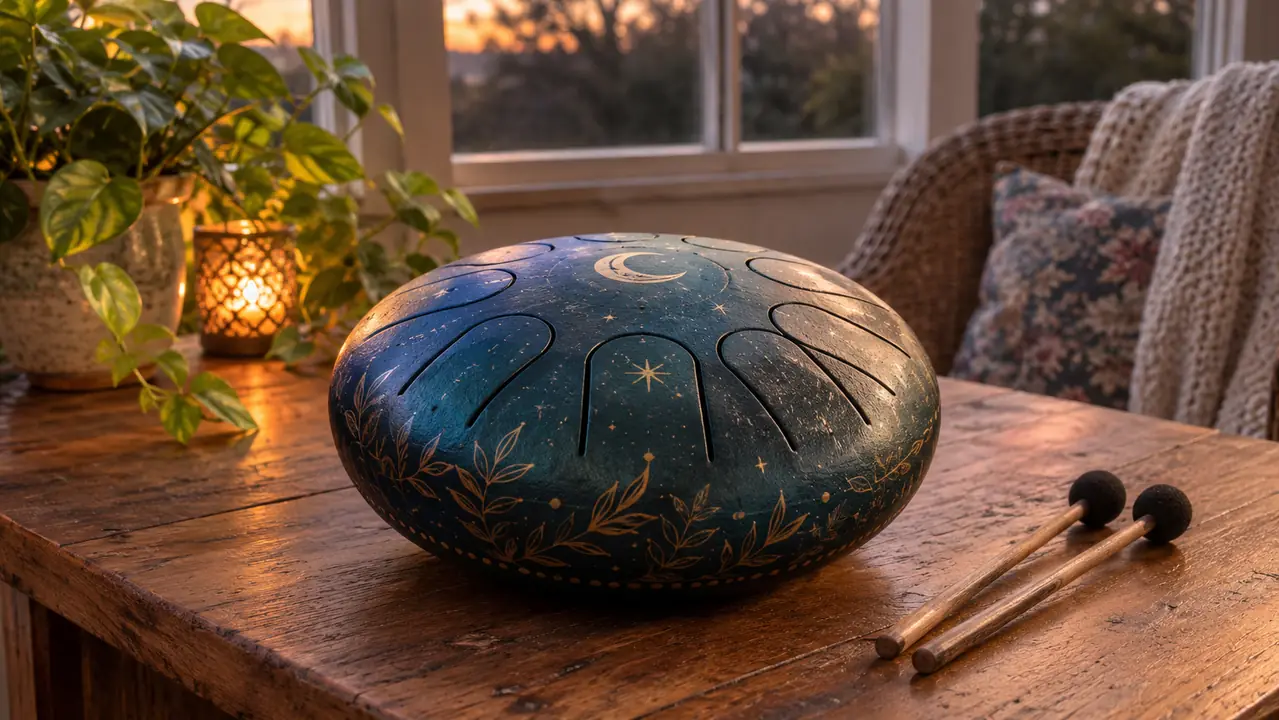
I bought the 15-note Hopwell steel tongue drum late last winter, mostly because I was tired of ending my evenings the same way: sitting on the couch, staring at a screen, feeling wired instead of settled. I am 57, I spent 24 years in community mental health work, and I know perfectly well that no instrument is a treatment for anything. But I also know what it feels like to sit in a room with a small drum and let your hands do something simple for ten minutes. So I ordered one, and I have played it most nights since. This is that story, with the good and the not-so-good.
The Quick Verdict
A well-built, genuinely pleasant 15-note steel tongue drum that rewards you on day one and keeps rewarding you for months. The D-major tuning means almost anything you play sounds okay, and the included book and carry bag make it easy to start and easy to store. It is not the most refined instrument I have heard, and the painted finish needs care. For a calm, hands-on evening ritual, it earns its place.
Amazon Check Today's Price →Want a calm evening ritual that does not require a single lesson?
The Hopwell 15-note steel tongue drum is the one I reach for most nights. It is tuned to D major, so even a beginner's fumbling sounds musical, and it comes with mallets, a music book, and a carry bag. Check today's price on Amazon to see if it fits your evening routine.
Amazon Check Today's Price on Amazon →How I've Used It
My routine is simple. Most mornings I play for about ten minutes with my coffee, and then again at night before bed. The drum lives in our back sunroom on a small wooden table, which means I do not have to dig it out of a closet to use it. That sounds like a small thing, but it is the whole trick: if the instrument is visible and ready, you will play it. If it is in a case under a pile of coats, you will not.
I ordered it on a Tuesday in late January, and it arrived four days later in a box that weighed more than I expected. The first evening I unpacked it on the kitchen table, read the small music book that came with it, and played the same three notes for maybe twenty minutes while Walt made dinner. I did not try to learn a song that night. I just wanted to hear what the drum could do. That first session taught me something I still rely on: the drum sounds best when you let it ring. I kept my hands loose, let each note fade before I played the next one, and the drum rewarded me with a tone I did not expect from a first instrument.
I have no formal training. I played piano badly as a kid and learned everything I know about these instruments by playing them. The Hopwell is a 12-inch steel tongue drum with 15 notes in a D-major key, and that tuning does most of the work for you. In D major, the notes relate to each other in a way that makes accidental combinations sound pleasant. I can sit down, close my eyes, and tap out something that sounds like a melody even when I am not really thinking about what I am doing.
My husband Walt, a retired bus mechanic who claims he is tone deaf, was skeptical at first. The first night I brought it home, he watched me play one note, then another, and said, "That sounds like a doorbell that lost its job." I laughed, set the drum down, and did not pick it up again until the next evening. Now he will sometimes sit in the sunroom and listen while he drinks his coffee. He still will not touch the mallets, but he stopped complaining about the noise months ago, which for Walt is practically a standing ovation.

What the 15-Note D-Major Setup Actually Means
The biggest question I get from friends is whether a 15-note drum is worth the extra money over a smaller one. In my experience, yes. The Hopwell's 15 notes in a D-major layout give you a full octave plus a few notes above and below, which means you can play actual melodies, not just pleasant patterns. The included music book uses number notation, so you do not need to read sheet music. You follow the numbers, and the numbers correspond to the notes stamped on the tongues.
The first song I learned was the folk tune in the front of the book, and it took me most of a week. The second song took two evenings. By the third month I could sit down, open the book to a piece I had never tried, and play it slowly on the first pass. That is the thing nobody tells you about a tongue drum: the instrument does not get easier, your hands learn where the notes live. The note stamps are legible, so even in low evening light I can glance down and find my place.
The book arranges everything in a simple number system, with the numbers printed right on the tongues, so I never had to translate sheet music. I keep a sticky note on the page I am working on, and I have learned to start each session by playing the last song I practiced once through before trying anything new. That small habit cut my frustration a lot. By the end of the first month I had four songs I could play without looking at the book, and that felt like more progress than I made in a year of piano lessons as a kid.
The sound profile is described by the manufacturer as clear and melodic, and I think that is fair. The drum has a soft, bell-like voice that carries just enough to fill a small room without overwhelming it. I can play in the sunroom while Walt watches television in the next room, and neither of us is annoyed. That is the balance I wanted: present enough to be satisfying, gentle enough to live with.
One thing I learned the hard way: the drum responds to how you strike it. If you hit the tongues hard, you get a sharp, slightly metallic note. If you use a lighter touch, you get a warm, round tone. Most beginners, myself included, start by hitting too hard. Give yourself a week to find the soft touch. The drum will sound noticeably better, and your wrists will thank you.
Build Quality and the Finish Question
The Hopwell is made of a titanium alloy, and it feels sturdy in a way that some cheaper steel drums do not. The body is handcrafted, according to the listing, and you can see it in the details: the tongues are cut cleanly, the note stamps are legible, and the drum sits flat on a table without wobbling. At 4.3 pounds, it is heavy enough to feel solid but light enough to carry from room to room.
The finish is painted, and this is where I have to be honest. The finish looks lovely in the sunroom, but painted finishes on steel drums are not indestructible. I keep the drum on a soft cloth when it is on the table, and I am careful with the mallets. After months of use, mine has a few tiny marks near the rim that you would only notice if you were looking for them. One evening in early spring I set the drum down without the cloth while I answered the phone, and when I came back the finish had picked up a faint scuff from a grain of something on the table. It is barely visible, but I noticed it. If you are the kind of person who wants an instrument to stay perfect forever, you will need to be gentle with this one.
The scuff happened on a Sunday afternoon in March. I had set the drum down on the bare table for just a minute while I went to answer the phone, and when I came back there was a faint pale line near the rim. I tried rubbing it with my thumb first, then a dry cloth, and neither did much. A slightly damp cloth helped, and I have used a soft cloth under the drum ever since. That one minute taught me more than any manual could: this finish is lovely, but it is not armor. A cork trivet or a folded dish towel under the drum is worth the trouble.
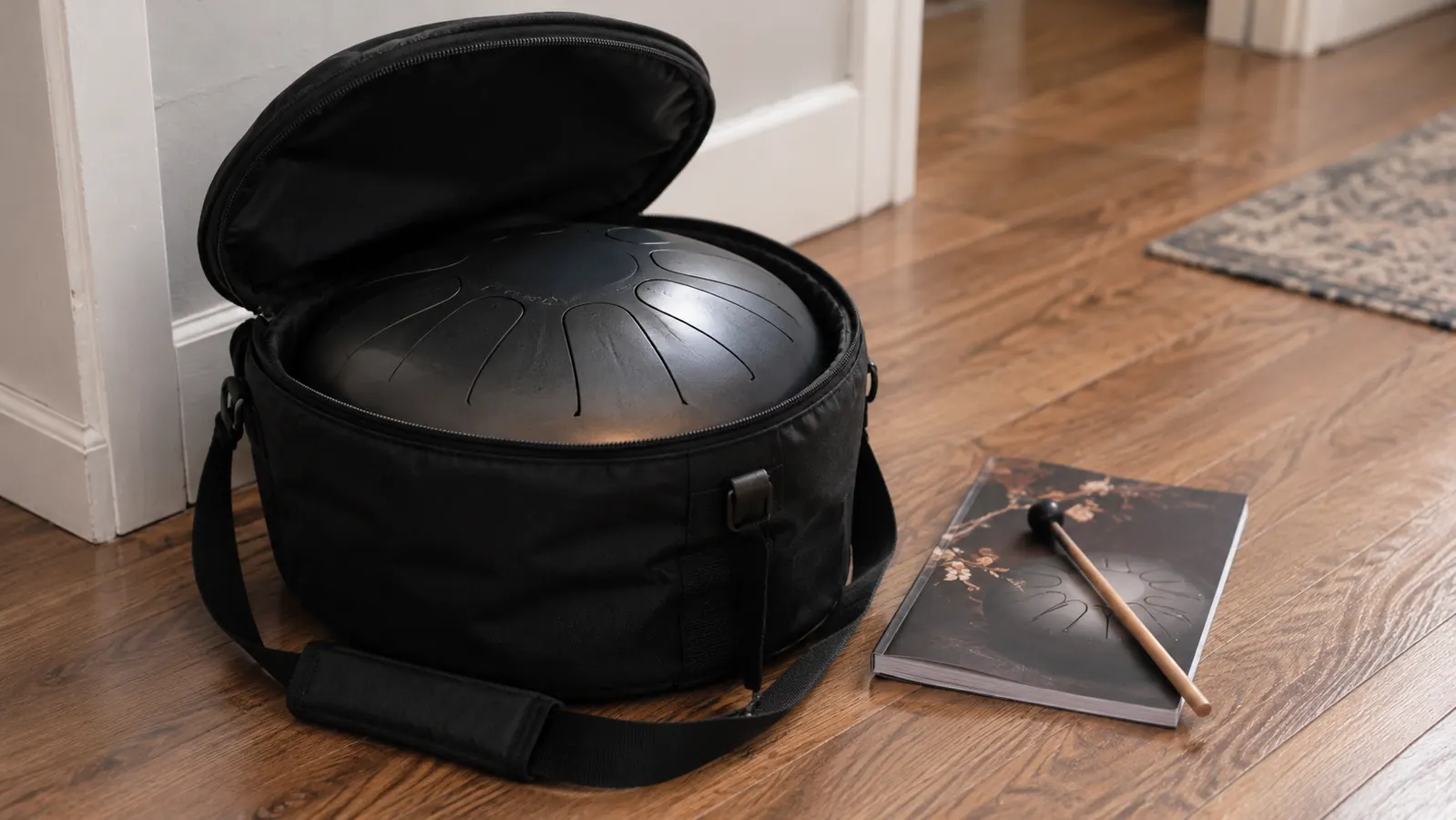
The included components are a case and a music book, and both are better than I expected for the money. The carry bag is padded and has a handle, which makes it easy to move the drum between the sunroom and, say, a friend's porch. The music book has a decent selection of songs arranged in number notation, from simple folk tunes to a few pieces I did not expect to be able to play. I have spent many evenings working through one song slowly, and the book has not run out of material yet. The listing also includes a 90-day manufacturer warranty, which is short but standard for instruments in this range.
How It Holds Up Over Months of Use
I have played this drum most nights for several months, which amounts to a few hundred sessions. The tuning has held. I check it occasionally against a tuner app on my phone, and the notes are still where they should be. That is the main thing I would worry about with a steel tongue drum, and this one has not drifted.
One night in late April, a thunderstorm knocked the power out for about two hours. Walt found a flashlight, and I sat in the sunroom and played the drum by flashlight. It was one of the best sessions I have had. The drum does not need electricity, it does not need an app, and it does not need me to be in any particular mood. It just needs my hands. That night I played the same three songs over and over, and the time passed without me noticing. When the lights came back on, I actually felt a little disappointed.
The mallets are another story, and I want to be straight with you. The ones that come with the drum are fine for the first month or two. After that, the rubber tips start to show wear, and I replaced them with a slightly softer pair that I prefer. The drum itself has held up beautifully; the included mallets are the weakest link in the package. That is a small thing, and replacement mallets are easy to find, but I would rather tell you now than have you discover it yourself.
I tried a few pairs of replacement mallets before I found the ones I like. The first pair I bought were too hard and made the drum sound tinny. The second pair were too soft and muffled the notes. The pair I settled on are a medium hardness, and they give the drum a warmer voice than the originals. If you buy this drum, expect to experiment a little. It is not a flaw in the drum. It is just that everyone's hands are different, and the mallets are the part of the setup you can adjust.
The painted finish has also required a bit more care than I expected. I wipe the drum down occasionally with a dry cloth, and I keep it out of direct sunlight when I can. These are small habits, not burdens. But if you are looking for a set-and-forget instrument, a steel tongue drum with a painted finish may not be that instrument.
What I Liked
- 15 notes in D major give a real range, so you can play melodies, not just patterns
- Titanium alloy body feels solid and sits flat without wobbling
- The number-notation music book means you never need to read sheet music
- Padded carry bag makes it easy to move around the house or take to a friend's porch
- Tuning has held through months of near-daily play
Where It Falls Short
- The painted finish scuffs more easily than I would like
- The included mallets wear down after a month or two and are worth replacing
- The voice is soft and intimate, so it will not fill a large room
- It asks for a little care: a cloth underneath, wiping down, keeping it out of direct sun
The tuning has held through months of near-daily play, and that is the thing I would have worried about most. A drum that goes out of tune is just a decorative bowl.
Who This Is For
This drum is for adults who want a calm, hands-on activity that does not require lessons, practice schedules, or any prior musical ability. It is for people who like the idea of an instrument but froze in music class as a kid. It is for the person who wants to end the day with something other than a screen, and who wants to see progress they can feel in their hands.
In my years as a community mental health caseworker, I brought a small hand drum to group sessions because it got people talking. I am not a music therapist, and I want to be clear that I am not making any medical claims here. But I do believe in the value of a simple, repeatable ritual. If you are looking for a way to unwind that does not involve a glass of wine or another episode of a show, this drum is a genuinely pleasant option.
Who Should Skip It
If you are a serious percussionist looking for a professional performance instrument, this is not that. The Hopwell is a home instrument, not a stage instrument. Its voice is soft and intimate, and it will not project over a room full of people.
If you are the kind of person who buys an instrument and expects to master it in a weekend, you will probably be disappointed. A steel tongue drum is simple to play, but the depth comes from repetition, from learning how the notes relate, from finding the soft touch. That is the whole point for me, but it is not for everyone.
And if you want an instrument you never have to think about, the painted finish and the wear on the included mallets will annoy you. This is a tool that asks for a little care. For me, that care is part of the ritual. For some people, it will be a chore.
Months in, I still look forward to my evening ten minutes
The Hopwell 15-note steel tongue drum has earned a permanent spot in my sunroom. If you want a calm, hands-on instrument that sounds good even when you do not know what you are doing, this is the one I would buy again. Check today's price on Amazon and see if it belongs in your evening routine too.
Amazon Check Today's Price on Amazon →