

If you have spent any time at all looking for a way to slow down at the end of a long day, you have probably seen a singing bowl on a screen and wondered whether the thing actually works when you are the one holding it. I wondered the same thing. I am Bernadette Lowry, and after twenty-four years in community mental health work, I have learned to be gently suspicious of anything that promises calm in a box. So when I ordered the Silent Mind Tibetan Singing Bowl Set, I did not expect a personality transplant. I expected a bowl. What I got, over six months of nearly daily use, was a small ritual that has quietly earned a permanent spot in my sunroom.
This review is about that long stretch of use: what the Silent Mind set feels like on day one, what it feels like on day one hundred, and whether a beginner-friendly bowl set is worth a place in your home. I will tell you straight up that I am not a musician and I am not a therapist. I am a retired caseworker who plays for about ten minutes most mornings with coffee and again at night before bed. That is the whole experiment.
The Quick Verdict
A beginner-friendly set with a clear, consistent tone that holds up beautifully over months of daily play and asks almost nothing of you in return.
Amazon Check Today's Price →A bowl that actually gets used, not just displayed
If you want a calm, hands-on instrument you will reach for most days, the Silent Mind set is the one I kept coming back to.
Amazon Check Today's Price on Amazon →How I've Used It
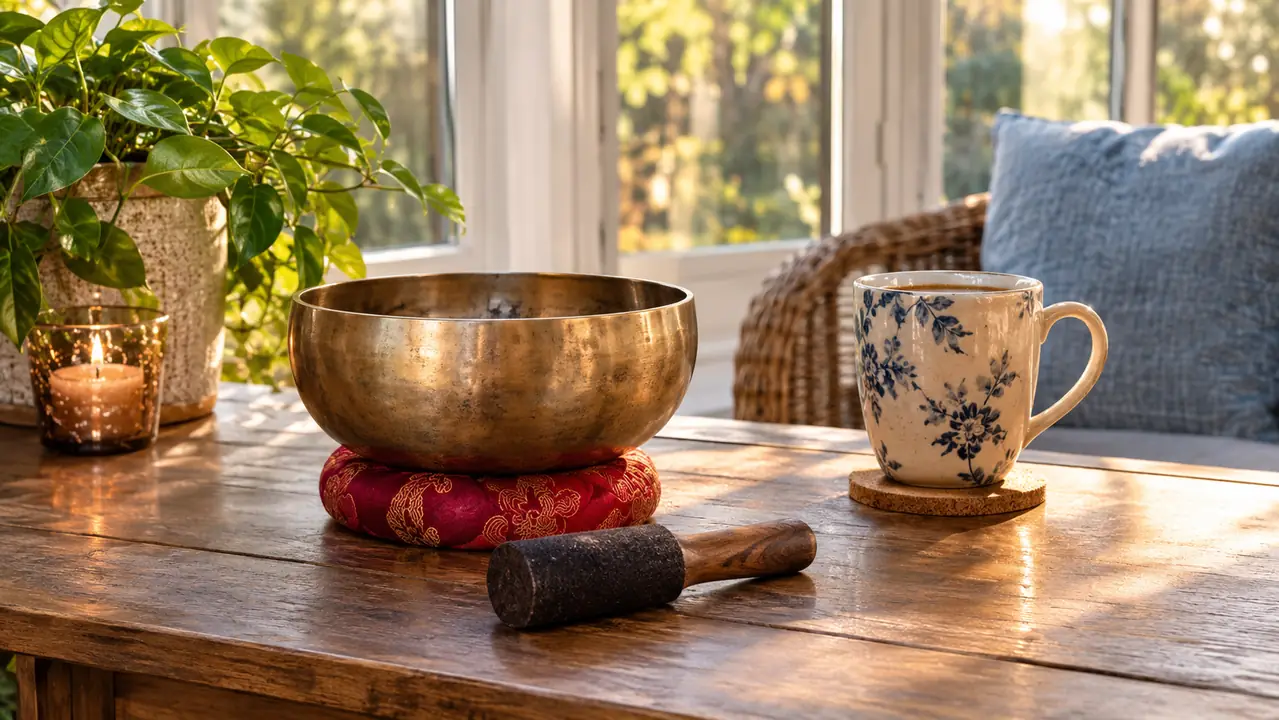
The set arrived in a box with three pieces: the bowl itself, a cotton cushion, and a wooden striker. The bowl is 3.94 inches across and 2.5 inches tall, which sounds small until you hold it. It fits in one hand. The cushion is a handwoven cotton pillow that keeps the bowl from sliding on the table, and the striker is a smooth piece of Himalayan wood that the listing calls the Easy-Play Striker. Everything came ready to use, and the included guide plus the downloadable eBook series made the first session painless.
My routine is simple. Most mornings I carry the bowl to the sunroom table with my coffee, set it on the cushion, and run the striker around the rim until the tone rises. It takes me about twenty seconds to find the right speed and pressure. Some days the bowl sings on the first pass. Other days it takes a few tries, and that is fine. The sound is a clear, resonant tone that fills the small room without ever feeling loud. At night I do the same thing for a few minutes before bed, often with the room lights low. My husband Walt, a retired bus mechanic who insists he is tone deaf, once told me he can hear the bowl from the kitchen and that it sounds pleasant through the wall. Coming from a man who claims he cannot tell one note from another, that is the closest thing to a review I am going to get.
I have also used the bowl during breathwork, which the product description mentions, and during quiet moments when I simply wanted a sound to anchor me. I have never used it for anything more complicated than that. I have dropped the striker once, knocked the bowl against the table edge twice, and left it sitting on the cushion in a chilly room for a week. It still sounds exactly the same. One Tuesday in late February, I knocked the bowl against the corner of the sunroom table while reaching for my coffee mug. It made a dull clank that I was certain had left a mark. I ran the striker around the rim anyway, and the tone came up clear on the first pass. I have not been able to make this bowl sound bad, which is more than I can say for any instrument I have owned before it.

What the Set Actually Includes
The Silent Mind set is built around one idea: you should not need a class to use it. The bowl is made from Tibetan bell metal, which the listing calls ancient Tibetan metalwork, and the finish is described as the Golden Serenity Bowl. The cushion is handwoven Tibetan cotton, and the striker is Himalayan wood. Every piece is ambidextrous, so left-handed players like me have no trouble at all. That last point matters more than you might think. I spent years assuming instruments were built for right-handed people and that I simply had to adapt. This is the first set I have owned where I never once had to think about which hand I was using.
What surprised me most is what came in the box beyond the three physical pieces. Silent Mind includes a detailed user guide, a premium eBook series, and a 3D sound bath audio track. The eBooks are not marketing fluff. They walk through basic playing techniques, how to hold the striker, how to rest the bowl on the cushion, and simple ways to build a daily ritual. For someone who has never touched a singing bowl, that material is worth real money. I read the first eBook on a Sunday afternoon in January, the same day the set arrived, and by that evening I had produced a clean, continuous tone for the first time. The 3D sound bath track is a different thing entirely. It is not instruction. It is a recorded audio track you can play in the background while you practice or just sit. I have used it maybe a dozen times, always at night, and it does what it says: it sounds like being inside a slow, wide wash of tone.
The bowl is also gift-ready, which I can confirm because I gave one to my daughter. She lives out of state, so I ordered it and had it shipped directly to her. She reported that the box arrived looking exactly like the listing photos, with the bowl, cushion, and striker all accounted for, and that the included guide made the whole thing feel less precious than she expected. She is not a wellness person by any stretch. She works long hours, and she told me she mostly uses hers on Sunday evenings while she reads. That is the use case the listing promises, and it is the use case I have seen hold up in real life.
Sound Quality and How It Holds Up Over Time
Here is the part I care about most. A singing bowl can look beautiful and sound dead, and a bowl that sounds dead will sit on a shelf. The Silent Mind bowl does not sound dead. The tone is clear and resonant, with a nice balance between the initial strike and the sustained ring. It is not the deepest, most complex bowl I have heard, but it is remarkably consistent for a set at this level. I have played bowls in shops that were far more expensive and sounded thin and uneven by comparison. This one produces the same clear note every time I play it, which is the quality I value most in any instrument I keep at home.
Over six months, I have noticed no change in the sound. The bowl has not dulled, the striker has not worn down, and the cushion has kept its shape. The cotton weave is still tight. The wood still feels smooth. I checked the bowl closely on day one and again on day one hundred and eighty, and I could not find a single mark on it, despite the two times I knocked it against the table. For a set at this level, that durability is the thing that most surprised me.
The only honest criticism I have of the sound is that the bowl is small, so the tone is brighter and shorter than a larger bowl. If you want a deep, long-sustaining drone that vibrates through the floor, you want a bigger bowl. If you want a clear, pleasant tone for a small room, this one is right. My sunroom is roughly the size of a large walk-in closet, and the bowl fills it completely without ever pushing. When I have carried it into the living room, which is bigger, the sound thins out noticeably. That is not a flaw in the bowl. It is a size fact, and knowing it before you buy will save you from the disappointment of expecting a floor-shaking drone from a 3.94-inch bowl.
Six months in, the bowl still sounds exactly like it did on day one, and that consistency is the whole reason it earns its place in my morning.
What It Does and Does Not Do
I need to be careful here, because I spent twenty-four years in community mental health and I have strong feelings about wellness products overpromising. The Silent Mind listing says the bowl helps create a grounding atmosphere for meditation, breathwork, or quiet moments. I will say this: the bowl does create a grounding atmosphere. The sound gives my brain something simple to follow, and the physical act of playing gives my hands something to do. That combination genuinely helps me settle. On a bad day in early April, I sat down with the bowl and ran the striker around the rim for about five minutes, and I noticed my shoulders coming down from around my ears. That is a real thing that happened. It is also a small thing, and I want to keep it small, because the moment I start promising more than that is the moment I stop being useful to you.
What the bowl does not do is treat anxiety, depression, stress, or any other condition. It is not a medical device. It will not fix a bad week. If you are struggling with your mental health, please talk to a licensed professional, because that is what actually helps. What a bowl can do is give you a small, repeatable moment of calm in your own home, and that is worth something. I used to bring a small hand drum to group sessions, and people would talk more easily while their hands were busy. The bowl works the same way for me now that I am retired. It gives my hands a job so my mind can slow down, and that is a mechanism I trust because I have watched it work on other people for decades.
I also want to be honest about the learning curve. The listing says the bowl is easy to play, and it is, but easy does not mean instant. The first few times I tried to run the striker around the rim, I got a stuttering, uneven sound, the kind that makes you wonder if you are doing it wrong. It took maybe ten minutes of practice before I produced a clean, continuous tone, and another few days before I could do it reliably with my eyes closed. The trick, which the eBook explains better than I can, is to keep the striker moving at a steady speed and let the bowl find the rhythm. Once I stopped gripping the striker like a screwdriver and relaxed my hand, the sound came out on its own. That is a very small investment, but it is an investment, and I would rather you know that going in.
What I Liked
- Clear, resonant tone that holds up after six months of daily play
- Everything you need in the box: bowl, cushion, striker, guide, eBook series, and a 3D sound bath audio track
- Ambidextrous design that left-handed players can use without adapting
- Gift-ready set that arrives looking like the listing photos
- Honest included materials that teach the basics without overselling
Where It Falls Short
- The 3.94-inch bowl sounds bright and short next to larger bowls, so it will not fill a big room with a low drone
- Easy does not mean instant: expect about ten minutes of practice before you get a clean continuous tone
- It is a relaxation tool, not a treatment, and it should never be sold as one
Who This Is For
This set is for adults who want a calm, hands-on instrument at home without taking a class, learning to read music, or spending a fortune. It is for people who already meditate, people who want to start, and people who simply like having a pleasant sound available at the end of the day. It is for anyone who has ever sat through a guided meditation and thought, I would like to make that sound myself.
It is also for gift givers. The set arrives looking intentional, the included materials make it easy for a beginner, and the bowl does not require a particular room, a power outlet, or any setup. My daughter is proof that you do not need to be a spiritual person to enjoy one.
Who Should Skip It
Skip this set if you want a large, deep-toned bowl for serious sound bath work. The 3.94-inch size is lovely for a small room, but it will not fill a large space with a low drone. Skip it if you expect instant calm and transformation from a piece of metal. It is a tool for a ritual, not a switch.
And if you are looking for a medical treatment, skip it entirely. A singing bowl is a lovely instrument, and I enjoy mine every single day. But it is not therapy, and it is not medicine. For that, please see a professional.
Six months in, still my favorite ten minutes of the day
The Silent Mind set is the bowl I reach for every morning and every night. If that sounds like the kind of calm you want at home, it is worth a look.
Amazon Check Today's Price on Amazon →