

I never set out to collect instruments. I was a caseworker for twenty-four years, and somewhere in the middle of that stretch I started bringing a small hand drum to group sessions because it got people talking. A drum does that. You pass it around, someone taps out a rhythm, and suddenly the person who has not said a word all hour has something to say about the beat. I retired a few years back, but the habit of reaching for something you can hold and play never really left me.
These days the instrument I reach for most lives in the sunroom at the back of our narrow two-story house. It is a Tibetan singing bowl set from Silent Mind, and it sits on a small table next to the chair where I drink my morning coffee. The set comes with the bowl, a handwoven cotton cushion, and an easy-play striker, which matters more than you might think when you have no formal training. I played piano badly as a kid and I never learned to read music properly, so I need instruments that do not require a lesson before they make a sound.

The evening ritual started by accident. Walt, my husband, a retired bus mechanic who claims he is tone deaf, was watching television in the living room and I was restless in the sunroom. I picked up the striker, ran it around the rim of the bowl the way the little guidebook showed me, and the bowl let out a clear, resonant tone that seemed to hang in the air longer than it should. I did it again. Then again. Ten minutes later I felt like I had exhaled something I had been holding all day.
Now it is the last thing I do most nights. I sit in the sunroom, the bowl on the cotton cushion in my lap, and I play for about ten minutes. Sometimes I do the breathwork the little eBook describes, sometimes I just listen. The vibrations are a grounding thing, a way to mark the end of the day, and I have come to look forward to it the way other people look forward to a glass of wine. Without the wine, mostly.
I am not going to tell you the bowl changed my life, because a bowl does not do that and I do not believe in pretending otherwise. What I can tell you is what I saw in twenty-four years of community mental health work: people settle faster when they have something to do with their hands. A bowl you can play, a drum you can tap, a chime you can ring. The instrument is not the treatment. It is the thing that helps a person slow down long enough to feel what they are feeling.
Ten minutes later I felt like I had exhaled something I had been holding all day.
Ready to build your own evening ritual?
The Silent Mind Tibetan Singing Bowl Set is made for first-time players, and it includes everything you need to start the night it arrives: the bowl, the cotton cushion, the easy-play striker, a detailed user guide, a premium eBook series, and a 3D sound bath audio track.
Amazon Check Today's Price on Amazon →The set is small, which is part of why it works for us. The bowl is about four inches across and two and a half inches tall, so it fits on the arm of a chair or the corner of a desk. It does not announce itself. It just sits there until you pick up the striker and give it a reason to sing.
Walt still claims he is tone deaf, and I still do not care. Some nights he wanders into the sunroom while I am playing, stands there for a minute, and then says something like 'that one sounded nice' before heading back to his show. That is the whole review I need from him, honestly. The man has sat through a lot of my experiments over the years, and he has never once told me a bowl sounded bad.
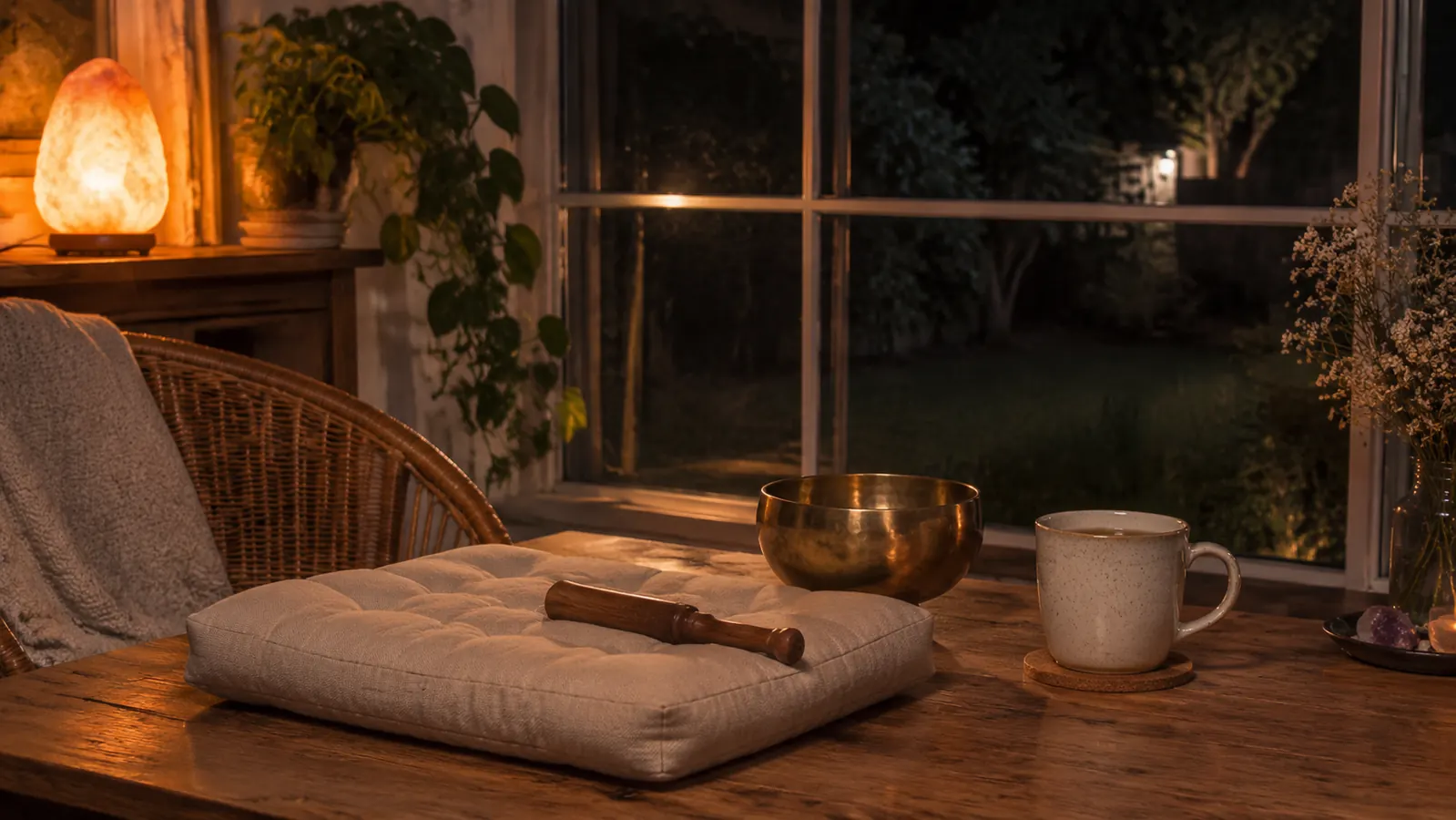
The included audio track and eBook series were a surprise to me, because I bought the set for the bowl itself. I am not someone who reads manuals, but the user guide is short and the sound bath track is just a recording of bowls, which I put on when I want the feeling of a group session without having to talk to anyone. It is a nice extra, not the main event.
The set also makes a surprisingly good gift. My daughter, who lives out of state, sent one to a friend last winter after she watched me play mine over a video call. She said it looked like 'the kind of thing that does not need instructions', which is about the highest praise she gives anything. I think she was right. The box is simple, the pieces are few, and the whole thing fits in one hand.
I should say what I always say when people ask me about these things: if you are struggling with anxiety, depression, or anything heavier than a long day, please talk to a licensed professional. A bowl is a lovely companion for a quiet evening. It is not a treatment for anything. What it can do is give you a small, repeatable ritual that belongs to you, and I have spent enough years in this work to know that rituals matter.
What I'd Tell You If We Were Sitting at My Kitchen Table
If you were sitting at my kitchen table, I would tell you this. You do not need to be musical to own a singing bowl. You do not need a meditation practice, a cushion posture, or a single piece of special clothing. You need a quiet corner, ten minutes, and a willingness to make an imperfect sound in front of no one but yourself.
I would also tell you to buy the set that comes with the striker and the cushion, because the first time I tried a bowl without them I spent the whole session trying to balance the thing on a folded towel. The Silent Mind set removes every excuse. Bowl, cushion, striker, guide, audio, all in one box. You open it, you sit down, you play. That is the whole ritual, and it is enough.
Give yourself ten quiet minutes tonight.
The Silent Mind Tibetan Singing Bowl Set includes the bowl, handwoven cotton cushion, easy-play striker, user guide, premium eBook series, and a 3D sound bath audio track, so you can start the same evening it arrives. No experience needed.
Amazon Check Today's Price on Amazon →