

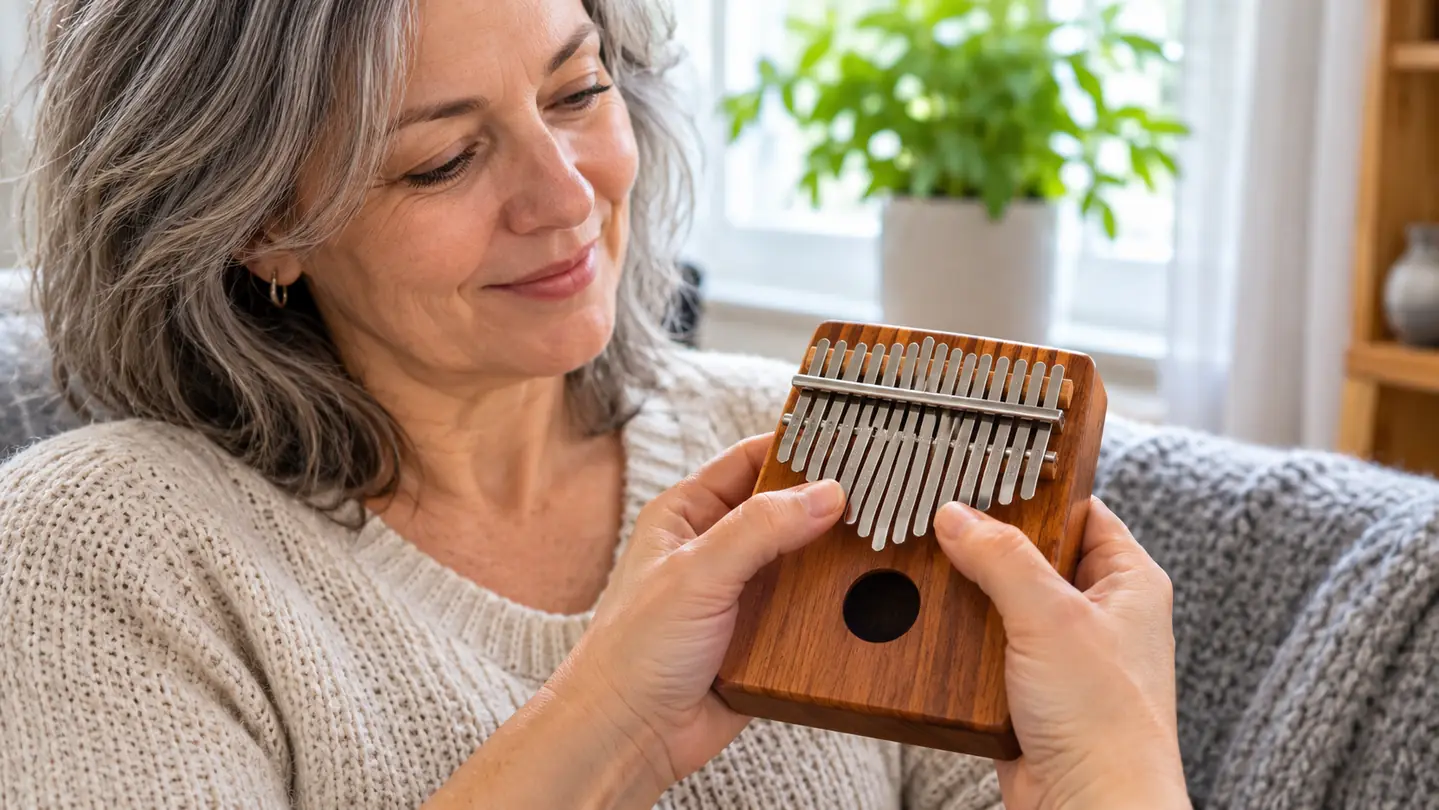
I bought the Newlam 17-key kalimba for the same reason I buy most of the instruments in my sunroom: I wanted something I could play badly without apologizing. After twenty-four years as a community mental health caseworker, I have watched a lot of stressed people settle down when they had something simple to do with their hands. A drum worked for me for years. Lately, I wanted a smaller voice. So I ordered the Newlam, opened the little instruction book, and started playing it with my coffee every morning.
What nobody tells you about the Newlam kalimba is that the first week is mainly about your thumbs, not the instrument. The wood is light, the seventeen keys are easy to reach, and the sound is genuinely lovely for an instrument this size. But your thumbs have to learn where the keys are, and that takes a few days of sore tips and missed notes. I have now played this kalimba most mornings and most evenings for close to three months. Here is the honest review, including the parts I would rather not admit about tuning.
The Quick Verdict
A warm, forgiving, genuinely pretty-sounding kalimba that is easier to learn than any instrument I have owned, held back only by tuning that needs more attention than the marketing suggests.
Amazon Check Today's Price →Want the kalimba that got me playing in one sitting?
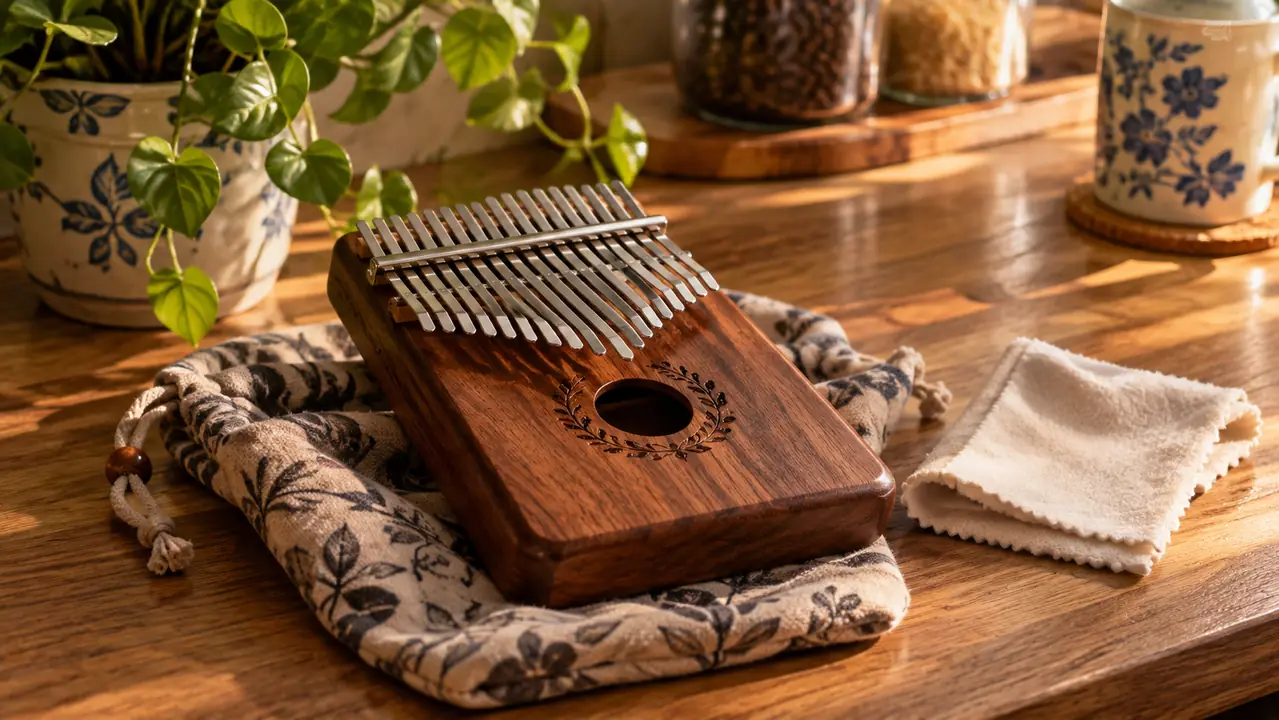
The Newlam 17-key thumb piano is the one on my sunroom table right now. It comes with the instruction book, the flannelette bag, and the cleaning cloth, and it is the instrument I reach for before coffee.
Amazon Check Today's Price on Amazon →How I've Used It
I play for about ten minutes most mornings with coffee, and again at night before bed. That is the whole routine. No metronome, no scales, no songs I have to finish. Some mornings I pick out a melody I half remember from childhood. Other mornings I just wander up and down the keys and let the notes ring into each other. The kalimba rewards that kind of wandering because the notes decay slowly, so even a clumsy run of keys sounds like a music box that is thinking about something.
The Newlam is set in C tuning, which means the keys are arranged around a center C in a pattern that looks strange at first and becomes obvious by day three. The engraved letters and notes on the keys are not a gimmick. They are the reason I could play a recognizable tune within five minutes, which is exactly what the listing promises. I have owned instruments that required a month of patience before they made a sound I wanted to hear again. This one did it in an evening.
I should be clear about my skill level. I played piano badly as a kid and I have no formal training. If I can learn this, the learning curve is genuinely flat. The keys are spring steel, so they respond to a surprisingly light touch. You do not need to strike hard. The lightest brush of the thumb produces a note that rings for a long time. That is the ethereal sound people talk about, and it is real, not marketing.
One morning a few weeks in, I sat down with the Newlam and tried to play 'Silent Night' from memory. I got through the first line before my thumb wandered onto the wrong key and the whole thing collapsed into a chord I had not meant to make. Walt looked up from his coffee and said it sounded fine to him, which is his way of saying he has no idea. I kept going. By the third morning I could play the whole first verse without stopping, and that small victory taught me more about the key layout than any diagram in the book. The pattern finally made sense in my hands instead of in my head.
What Nobody Tells You Before You Buy
The first thing nobody tells you is that tuning takes a little attention. The Newlam does not arrive perfectly in tune, and it will not stay perfectly in tune for long. The instruction book explains the note layout and the included play guidance gets you started, but nothing in the box tells you how often the wood will settle. In the first few weeks I checked the tuning every few days, because the notes drifted while the wood adjusted to the house. This is normal. It is not a defect. But it is the single biggest gap between the marketing and the reality.
The second thing nobody tells you is that the flannelette bag is simple rather than padded. It protects the kalimba from dust and from the cat, if you have one. It will not protect the instrument from a drop onto a hard floor. I keep mine on a low shelf in the sunroom, and I am careful when I carry it to the kitchen. The included cleaning cloth is useful, because the keys pick up fingerprints quickly and the wood shows every smudge. Neither of those is a reason to skip the Newlam. They are just the realities of owning a wooden instrument with metal keys.
The third thing is the one I feel most strongly about. The Newlam is sold as a gift for kids and adults, and it genuinely works for both. But the marketing makes it look like a toy, and it is not a toy. It is a real instrument with real tuning needs and a real voice. If you buy it for a child, expect to do the tuning for them. If you buy it for yourself, expect to spend a few minutes every week or two checking the notes. That is the honest trade for an instrument that costs what this one costs.
The first time the tuning drifted noticeably, I thought I had broken it. One evening the sunroom had gone from warm afternoon sun to cool evening air in the space of a few hours, and when I sat down to play, the center key sounded dull, almost buzzy. I nearly put the kalimba away and told myself I would deal with it later. Instead I fetched my small mallet from the kitchen drawer, tapped the key twice, and the note came back clean. That was the moment I stopped treating tuning as a chore and started treating it as part of owning the instrument. It takes me less time now than it takes Walt to make a pot of coffee.
What I Liked
- Engraved letters and notes on every key make the layout learnable in an evening
- Warm, ringing C-tuned sound that rewards a gentle touch
- Comes with instruction book, flannelette bag, and cleaning cloth
- Light at 11.52 ounces, easy to hold for a full ten-minute session
Where It Falls Short
- Tuning drifts, especially in the first month while the wood settles
- Flannelette bag is simple rather than padded, so drops are risky
- No tuning mallet in the kit, so you will need your own
- Quiet voice that disappears next to other instruments
The engraved letters and notes on the keys are not a gimmick. They are the reason I could play a recognizable tune within five minutes.
Tuning Tips for People Who Have Never Tuned Anything
Here is what I learned about tuning the Newlam, and I learned it by making every mistake available. First, tune in a quiet room. The kalimba is quiet, and you need to hear the note clearly. Second, use a free tuning app on your phone. The app tells you whether a note is flat or sharp, and it is far more reliable than my ear. Third, tap the tine gently with a small mallet. The kit does not include one, which surprised me, so I use a rubber-tipped mallet I already owned. Tap, listen, tap again. Do not force it. The tines move in small increments, and it is easier to tap five times gently than to tap once hard and overshoot.
The most important tip is also the most counterintuitive: tune from the center out. The center key, the C, is the anchor for the whole instrument. If the center is off, everything else sounds wrong even when it is technically correct. I start with the center key, then tune the keys immediately to the left and right, then work outward. It takes me about ten minutes now. The first time, it took me forty-five and I still had two keys I was not sure about. That is normal. Your ear gets better fast.
One more tip that nobody puts in the book: the wood responds to temperature and humidity. My sunroom gets cold in the winter and warm in the summer, and the tuning drifts more at the extremes. I do not tune the Newlam every day. I check it once a week, and I always check it after a big temperature change. If you keep your kalimba in a room that stays close to the same temperature, you will tune it far less often. That is the kind of practical detail I wish someone had told me on day one.
My first tuning attempt was a masterclass in doing it wrong. I tuned in the kitchen with the kettle hissing, I tapped the tines too hard, and I worked from the outside in, which meant every key I adjusted seemed to throw the next one off. By the end I had made the instrument worse and I was ready to blame the kalimba. The next evening I tried again in the quiet sunroom with a free tuning app on my phone, and the difference was immediate. The app shows you a little needle and tells you whether the note is flat or sharp. When the needle sits in the middle, you are done with that key. I now check all seventeen keys in about ten minutes, and I only touch the ones that need it.
The Sound, Honestly Described
The Newlam's sound profile is described as rich and ethereal, and I think that is fair. The lower keys have a soft, wooden thump underneath the ring, which gives the instrument more body than I expected from something this size. The upper keys are brighter and more delicate. The whole instrument sounds like a music box that has been left in a warm room. It is not loud. You will not fill a room with it. You will fill a corner of a room, and that is exactly what I want at seven in the morning.
The seventeen keys give you a range that surprises people. I can play melodies that need more than an octave, which is something a smaller kalimba cannot do. The trade is that the instrument is a little wider and a little heavier than the smaller ones. At 11.52 ounces, it is light enough to hold for a full ten-minute session without your hands cramping, but it is not pocket-sized. The dimensions, 7.08 by 5.08 by 1.18 inches, make it a lap instrument or a table instrument. I play it on my lap in the sunroom, and I set it on the kitchen counter when I am waiting for the kettle.
The wood is naturally air-dried, and the listing makes a point of the raw materials selection. I cannot verify the drying process, but I can tell you that the wood feels stable and pleasant in the hand. It is not a glossy, lacquered instrument. It is matte and warm, and it smells faintly of wood when it is new. That smell fades. The feel does not.
The clearest test of the sound came one evening when my daughter called from out of state and I played for her over the phone. She laughed and said it sounded like a music box from her childhood, the one her grandmother kept on the dresser. That is the closest I can come to describing it honestly. The Newlam does not sound like a performance instrument. It sounds like a memory, soft and a little wistful, and the notes hang in the air long enough that you can hear the next one before you play it. For someone who wants to relax rather than impress, that is exactly the right voice.
Who This Is For
The Newlam kalimba is for adults who want a calm, hands-on instrument that does not demand formal practice. It is for people who played piano badly as kids and gave up. It is for people who want something to do with their hands while they think, and for people who want a reliable little ritual at the start or end of the day. It is for anyone who has ever watched a video of someone playing a kalimba and thought, I could do that. You can. The learning curve is genuinely that flat.
It is also a good gift for a child, with one honest caveat. The instrument itself is sturdy enough for careful hands, but the tuning requires an adult. If you are buying the Newlam for a kid, buy it knowing that you are the tuner. That is a small job, and it is a good way to spend ten minutes with a child, but it is a job.
Who Should Skip It
Skip the Newlam if you want an instrument you never have to tune. Every kalimba needs tuning eventually, and this one needs it more often in the first month than the marketing suggests. If that sounds like a chore, this is not the instrument for you. Skip it if you want something loud enough to play along with other people. The kalimba is a solo voice. It will disappear next to a guitar or a drum. And skip it if you want a pocket-sized instrument. At 7.08 by 5.08 by 1.18 inches, it is lap-sized, not pocket-sized.
I would also gently suggest that anyone buying this as a gift for a person who does not like fiddly maintenance should think twice. The tuning is not hard, but it is fiddly, and tapping the tines into place requires a steady hand. My husband Walt, who claims he is tone deaf, will not go near the tuning. He plays the kalimba happily, and he hands it to me when it needs tuning. If your gift recipient is a Walt, you are the tuner. Go in with your eyes open.
Ready to find out if your thumbs can make this sound?
The Newlam 17-key kalimba has been on my sunroom table for months, and it is still the first thing I reach for in the morning. It comes with the instruction book, the flannelette bag, and the cleaning cloth, so you have everything you need to start today.
Amazon Check Today's Price on Amazon →