
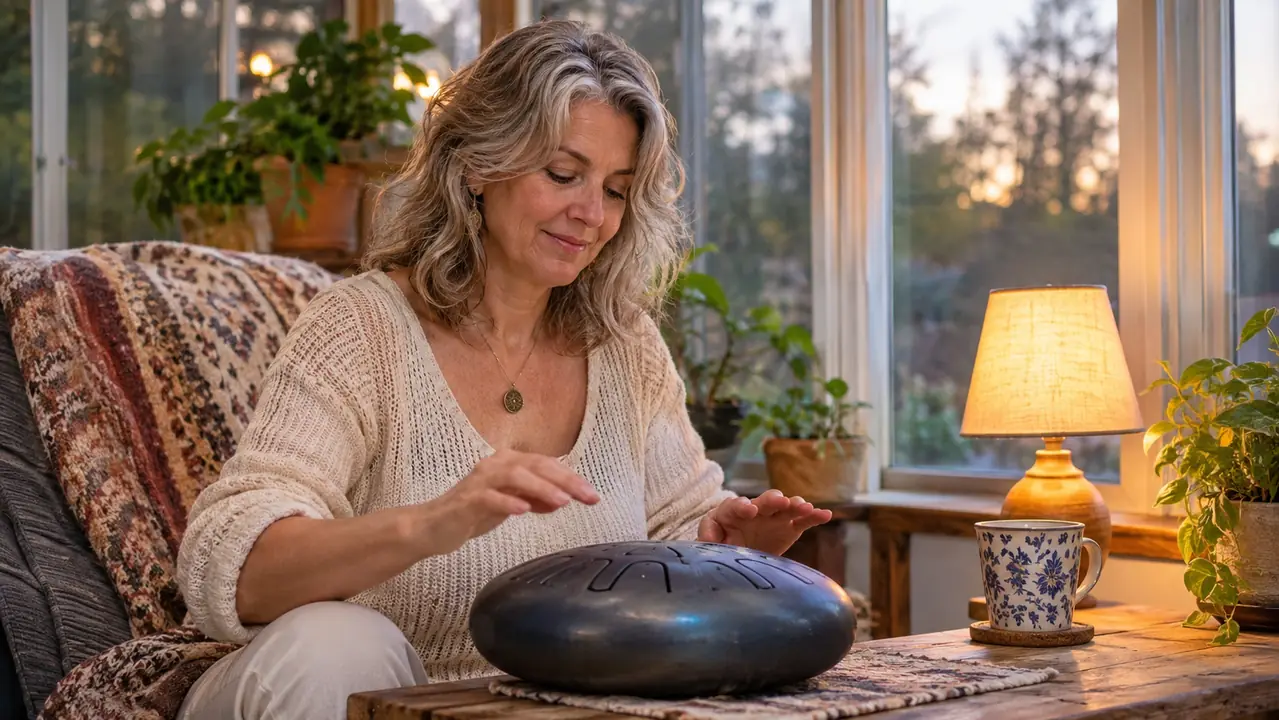
If your evenings end the way mine used to, you spend the last hour before bed doing things that are supposed to be relaxing and then wondering why you feel more wired than when you started. You scroll, you watch something, you check the news one more time. Your brain keeps turning over the day while your body is trying to slow down. What finally helped me was not another app or another breathing exercise. It was a steel tongue drum I keep in the sunroom, and a simple five-step wind-down I built around it.
I am Bernadette Lowry. I spent 24 years in community mental health, and I learned early that a small instrument often helps a person settle faster than a lecture does. The HOPWELL steel tongue drum I play at night is a 15 note, 12 inch drum in D major. It has a clear, melodic sound that does not ask anything of you. You do not need to know music. You do not need to be good. You just need to sit still and let the notes give your breathing something to follow.
The 15-note HOPWELL drum that made my evenings quieter
It is 12 inches across, tuned in D major, and it comes with mallets, a music book, and a carrying case. At 4.3 pounds, it is easy to move from the sunroom to wherever you sit at night.
Amazon Check Today's Price on Amazon →Why a Steel Tongue Drum Works for Wind-Down
A tongue drum is about as close to a no-skill instrument as I have found. You tap the metal tongues with your fingers or with the mallets, and the note rings out on its own. There is no embouchure, no chord shape, no tuning peg. The drum is already tuned. You just have to show up and tap.
The HOPWELL version has 15 notes in a D major arrangement, which gives you room to wander without ever sounding harsh. The body is made from titanium alloy, and the finish is painted, so it holds up to daily use. Mine has lived on the low table in the sunroom for months, and it still sounds as clear as the day it arrived. It also carries a 90 day manufacturer warranty, which is a small thing until you need it.
What Comes in the Box
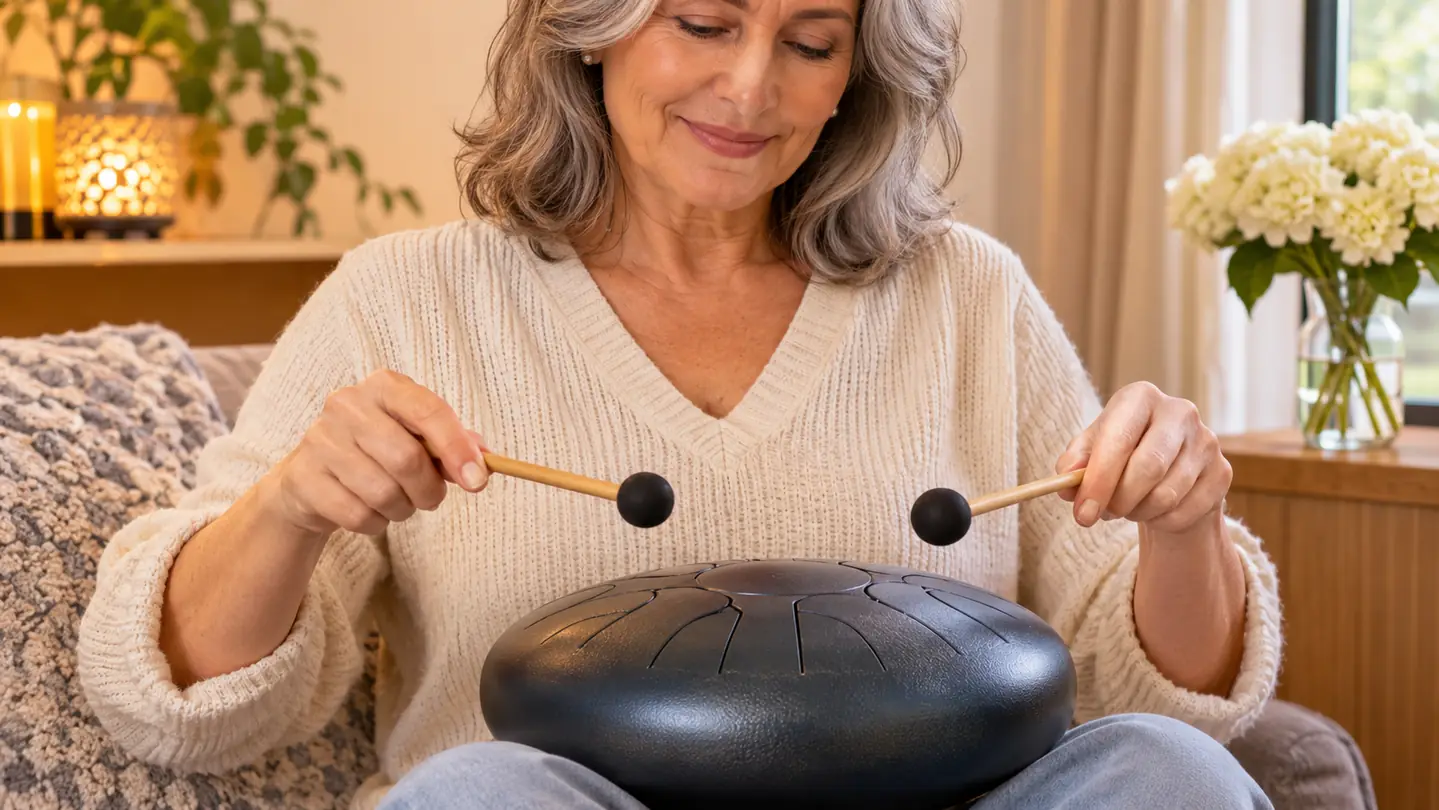
The HOPWELL drum arrives with the essentials: a pair of mallets, a music book, and a carrying case. The mallets give you a clearer, louder tone than your fingers. The music book is simple enough for a beginner. The carrying case protects the drum when you travel or when you want to move it from the sunroom to the bedroom.
The drum itself is 12 inches across and weighs 4.3 pounds, so it is easy to handle. The titanium alloy body feels solid without being heavy. The painted finish has held up well in my house, and the 90 day manufacturer warranty covers you if anything is wrong when it arrives.
What If You Have Never Played an Instrument?
This is the question I hear most from friends who visit and see the drum on the sunroom table. They say, 'I have no musical bone in my body.' I say the same thing about myself. I played piano badly as a kid and did not touch another instrument for decades. A tongue drum is different because it does not ask you to read music or coordinate two hands in different rhythms.
The 15 notes are laid out in D major, and the drum is tuned before it reaches you. You cannot play a wrong note in the way you can on a guitar or a flute. That forgiveness is exactly what makes it work at the end of the day, when your brain is tired and your standards should be low.
If you want a little structure, the included music book has simple songs with numbered notes. You do not need to read sheet music. The numbers tell you which tongue to tap. Most nights I do not even open the book. I just play the same three notes and let the routine do the work.
Step 1: Choose the Same Spot and the Same Time
The routine matters more than the instrument. Pick a spot where the drum can live out in the open, not buried in a closet. For me that is the low table by the window in the sunroom. The drum sits there all day, so there is no setup and no excuse.
Pick a time that is late enough that the day is done, but early enough that you are not already exhausted. I aim for about thirty minutes before I want to be in bed. Walt knows that when he hears the first few notes, I am done with the day. He claims he is tone deaf, but he will still sit in the doorway and listen for a few minutes.
Keep the lighting low. I use one small lamp instead of the overhead light. The point is to tell your body that the bright, busy part of the day is over.
Step 2: Start with Your Hands, Not the Mallets
I like to begin by tapping the drum with my fingertips. The pads of your fingers give a softer sound than the mallets, and they force you to slow down. Rest the drum on your lap or on the table in front of you, and tap the tongues one at a time, just to hear where the notes live.
The HOPWELL drum has 15 notes arranged in D major, so the scale is forgiving. You do not have to hunt for a melody. Tap a few notes in any order and the sound stays pleasant. That is the whole point of a wind-down instrument: it rewards wandering instead of punishing it.
After a minute or two, pick up the mallets if you want a louder, clearer tone. The mallets come with the drum, along with the music book and the carrying case. Use them or don't. There is no right way to start.
Step 3: Play the Same Three Notes for a Few Minutes
Once your hands have found their way around the drum, choose three notes that sit next to each other. Tap them slowly, one after the other, and let each note fade before you play the next. One, two, three. One, two, three. It sounds simple because it is simple.
Repetition is what does the quiet work. Your hands have a job, your ears have something to follow, and your mind stops rehearsing tomorrow. I am not promising a medical outcome. I am just describing what happens when you give a busy brain a gentle pattern to hold onto.
If your mind wanders, let it wander. The drum will still be there when you come back. The only rule is to keep the tempo slow. This is not a performance. It is a way to practice being done.
Step 4: Stop While You Still Want More
The first few nights I played until I was tired of the sound. That was a mistake. A wind-down should leave you a little bit hungry for the next session, not bored of the one you just had.
Now I set a loose goal of ten minutes. Sometimes I play for five. Sometimes I play for fifteen. The important thing is to stop while the drum still feels like a treat. That little bit of wanting is what brings me back the next night.
If you are the kind of person who turns everything into a project, resist the urge to track your progress. There is no progress to track. You are not learning a song. You are learning to end your day on purpose.
Step 5: End with a Single Long Note
When you are ready to finish, tap the lowest note on the drum and let it ring. Put the mallets down while the sound is still hanging in the air. Let the note fade on its own. Then sit in the quiet for a few seconds before you move.
That final note is the signal. It tells the room, and tells you, that the playing is over and the evening can move toward bed. I turn off the lamp, set the drum back on the low table, and head upstairs. The whole routine takes about ten minutes.
The HOPWELL drum is light enough at 4.3 pounds to carry with you if you want to play in the bedroom instead. I keep mine in the sunroom because that is where the routine lives. But the carrying case makes it easy to take along when we visit our daughter out of state.
What to Expect the First Few Nights
The first night, you may feel a little awkward. That is normal. You are not used to sitting with an instrument, and your hands do not know where to go. Give yourself permission to sound like you are just tapping metal. Within a few nights, the notes will start to feel familiar, and your hands will find the tongues without looking.
The second thing you may notice is that the drum does not need to be played well to sound good. Because it is tuned to D major, even a slow, random pattern sounds calm. That is the whole trick of a wind-down instrument: it meets you where you are.
How Long Should You Play at Night?
Ten minutes is a good starting point, but it is not a rule. Some nights I play for five and feel done. Other nights I lose track of time and play for twenty. The length matters less than the fact that you showed up and sat still with a pleasant sound for a few minutes.
If you are new to the drum, start with five minutes for the first week. Let the habit build before you worry about the duration. A short routine you keep is worth more than a long one you abandon.
What Else Helps
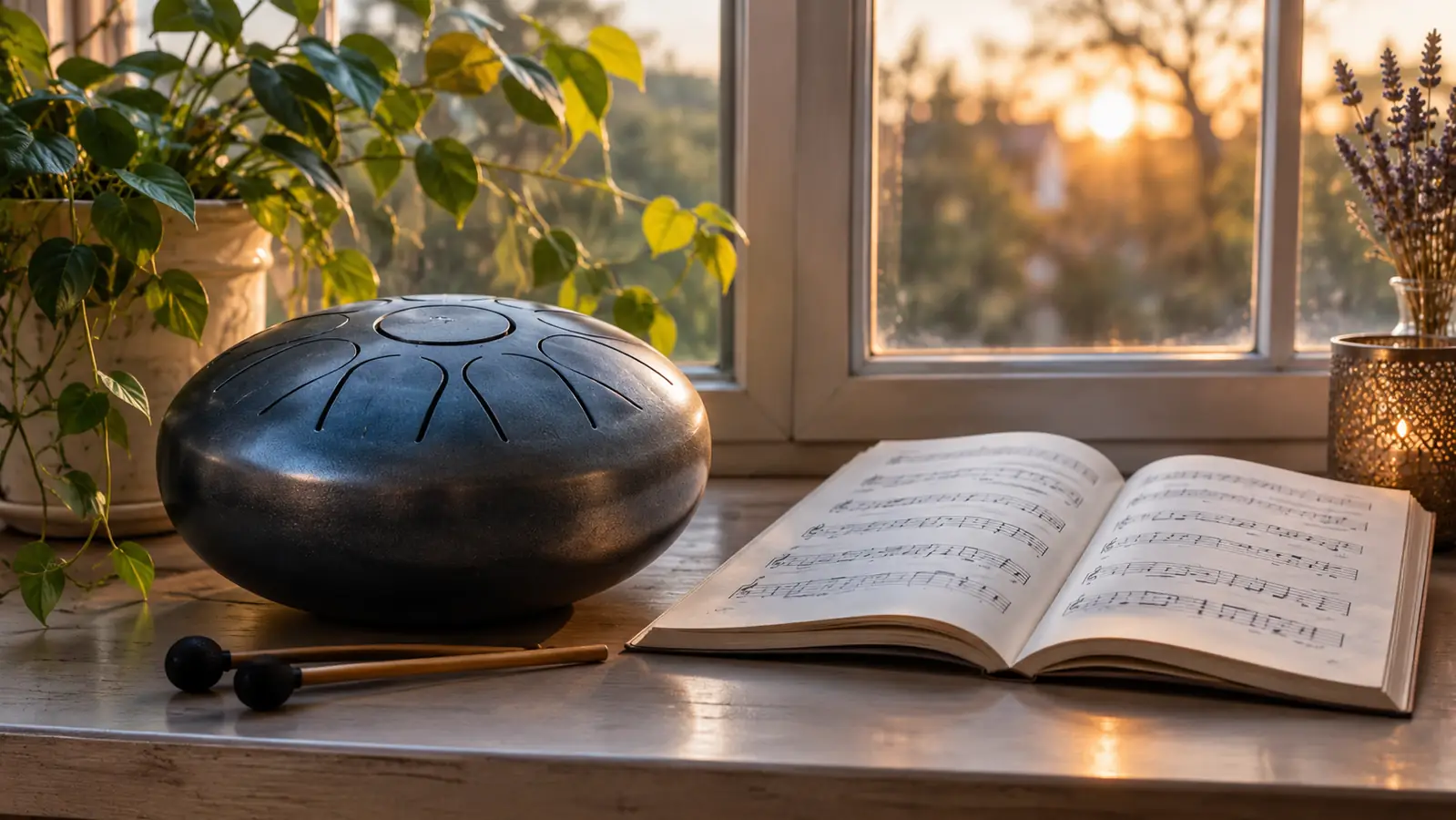
A few small things make the routine stick. Keep the music book that comes with the drum somewhere you can see it. Some nights I follow one of the simple songs. Most nights I do not. The book is there when I want structure and ignored when I do not. That is the right balance for a wind-down.
If you are dealing with anxiety, depression, or sleep trouble that feels bigger than a busy brain, please talk to a licensed professional. I spent 24 years in community mental health, and I believe in the power of small rituals. I also know they are not a treatment. A drum is a lovely companion, but it is not a replacement for the right kind of help.
One more thing: keep the drum somewhere you will see it. Mine sits on the low table in the sunroom, not in the carrying case in a closet. The case is great for travel, but a drum that is out of sight is a drum that does not get played. Make it easy for your future self to sit down for ten minutes.
I also like to have a cup of tea nearby, not because the tea matters, but because it gives my hands something to do between rounds. The drum does the same thing. It gives you a place to put your attention that is not a screen and not a worry.
Why This Routine Works for Me
I have spent most of my adult life in rooms full of people who were carrying heavy things. I learned that sometimes the most useful thing you can offer is not advice but a way to be busy with your hands while your mind takes a break. That is what this drum does for me at night.
Walt will tell you I am not a musician. He is right. I do not read music well, and I cannot play a song on request. But I can sit in the sunroom with a cup of tea and a steel tongue drum, and ten minutes later I feel like the day is actually over. That is enough.
Ten minutes of slow taps on a 15-note D major drum settles my evenings better than any app I have tried.
Give yourself ten minutes with a drum that asks for nothing
The HOPWELL steel tongue drum is the one I reach for at night. It is 15 notes, D major, and it comes with mallets, a music book, and a carrying case. If that sounds like the calm you are after, today's price is worth a look.
Amazon Check Today's Price on Amazon →