

If you have ever wanted an instrument you can actually play, not just one you admire, the kalimba is the one I hand people first. I am Bernadette Lowry. I spent 24 years in community mental health work, and for about ten of those years I carried a small hand drum to group sessions because it got people talking. When I retired, I wanted something gentler for my own sunroom in Albany. The Newlam 17-key kalimba is what has stayed on the table by my coffee mug.
The whole point of this guide is that you do not need to read music. You do not need to have played anything before. You do not need to be musical. You need a quiet half hour, a kalimba with the letters marked on the keys, and one simple song. That is the entire list.
Start with an instrument that makes the first song easy
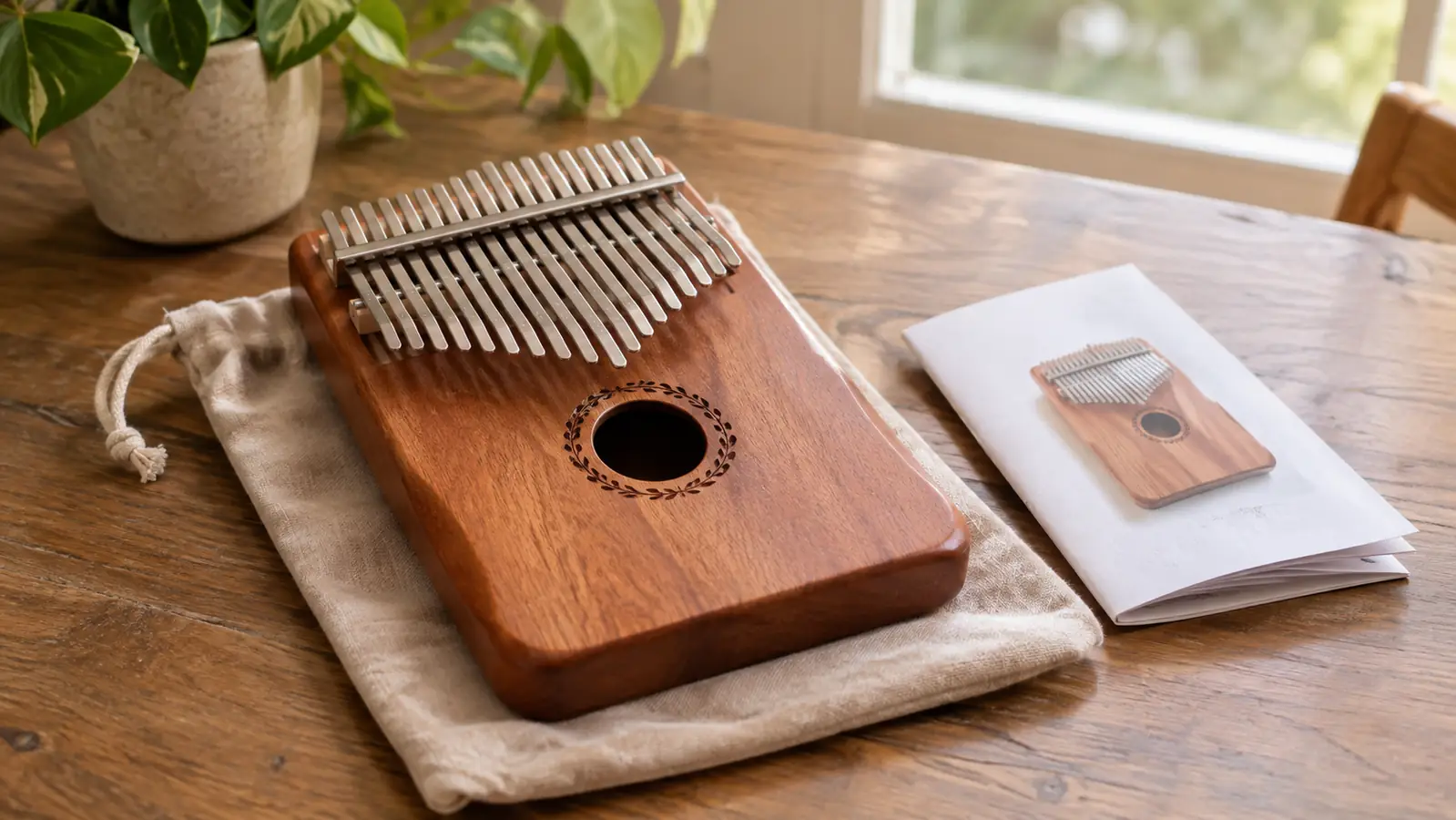
The Newlam 17-key kalimba has the note letters engraved right on the keys, so your first song is mostly a matter of following the marks. It comes with an instruction book, a flannelette bag, and a cleaning cloth. That is everything you need for this guide.
Amazon Check Today's Price on Amazon →Step 1: Unbox Everything and Get Acquainted
When the box arrives, open it somewhere you will not be rushed. I opened mine at the kitchen table on a rainy Tuesday morning, and I am glad I did. The Newlam kalimba comes with an instruction book, a flannelette bag, and a cleaning fabric. Take each piece out and set it on the table. The kalimba itself is 7.08 x 5.08 x 1.18 inches and weighs 11.52 ounces, which means it is small enough to rest in your palms and light enough to hold for a long time without your hands tiring. The wood is naturally air-dried and the tines are spring steel, a combination that feels sturdier than it looks.
Look at the top of the instrument. You will see 17 metal tines, and on the keys themselves you will see embossed letters and musical notes. This is the feature that makes the Newlam kalimba forgiving for a beginner. The letters tell you which note each tine plays. You do not have to memorize anything or count tines from either side. The instrument is basically labeled for you. I have handed this instrument to people who swore they were not musical, and the first thing they do is tip it toward the light to read the letters, like a person checking a map. That is exactly the right instinct.
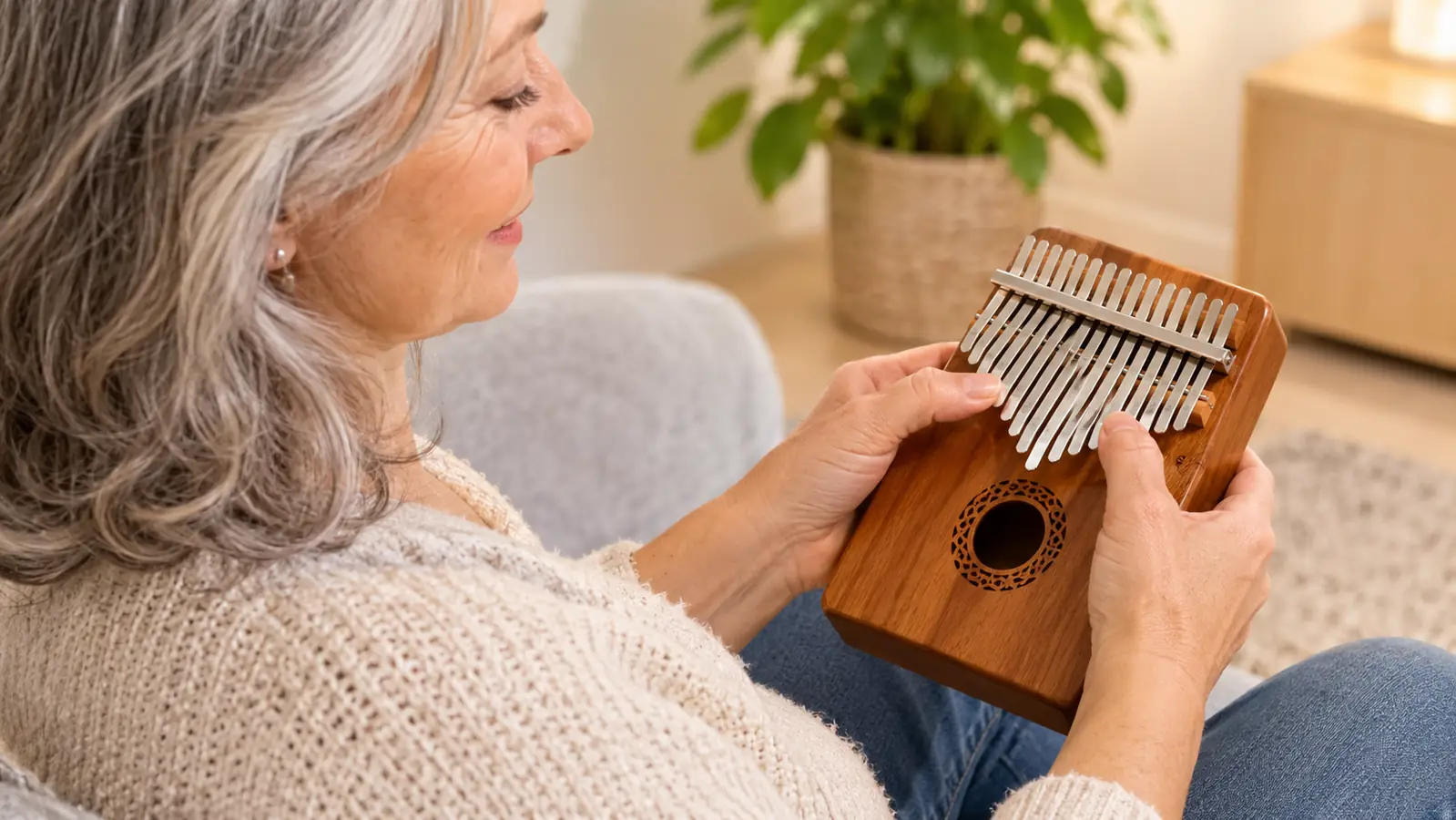
Before you play anything, get comfortable with how it sits. The kalimba rests in your two palms, with the tines pointing away from you and the longer tines in the middle. Your thumbs hang over the tops of the tines, loose and relaxed. That is the whole playing position. If your shoulders are up near your ears, drop them. The instrument should feel like something you are holding, not something you are gripping. One thing I tell everyone: lift it by the wooden body, not by the tines. The tines are spring steel and they are forgiving, but there is no reason to test that on day one.
Step 2: Learn the Notes You Actually Need
You do not need all 17 keys today. In fact, I would tell you to ignore most of them for the first session. A kalimba in C tuning is laid out so that the middle tine is the note C, and the notes go up the scale as you move outward to the left and right. For a first song, you will use a small handful of notes near the middle of the instrument. The engraved letters on the keys will point you to them every time. The C tuning matters more than you might think. It means the instrument is set to the key most simple songs already live in, so you are not fighting the instrument to find a tune you recognize.
Here is the part that surprises most adults: the kalimba is not a piano. On a piano, the low notes are on your left and the high notes on your right. On a kalimba, the lowest note is on the far left, but the scale climbs toward the middle and then continues upward on the right side. The middle tine is the center of everything. Do not try to understand the whole layout at once. Just find the middle C, find the few letters your song needs, and let the engraving do the remembering for you. I played piano badly as a kid, so my brain kept insisting the low notes belonged on the left. It took me a full session to stop reaching for notes in the wrong place. That is not a sign you are doing anything wrong. It is just an old habit letting go.
Pluck one tine at a time with the pad of your thumb, not the nail. The nail gives a thin, clicky sound. The pad gives the warm, rounded tone you hear in recordings. Let the tine ring for a few seconds before you pluck the next one. This instrument rewards patience. If a note sounds buzzy, your thumb may be touching the neighboring tine, or you may be plucking too hard. Ease off and try again. The first time I heard the difference, I laughed out loud in my sunroom. One change, the pad instead of the nail, and the whole sound opened up.
Step 3: Play Your First Melody, One Note at a Time
The Newlam instruction book includes simple play guidance, and the maker says you can master your first song within 5 minutes. I have watched enough grown adults do this to believe it, with one caveat: you have to pick the right first song. The best first song is one you already know by heart, because then your ears tell you when you hit a wrong note. You do not have to read music. You just have to recognize the tune. My first attempt was a mistake, and it is worth telling you about. I tried "Amazing Grace" because it is a song I have known for decades. The melody jumps around more than it looks like it does, and my thumbs kept hunting for notes that were not where I expected them. I put the kalimba down, made a second cup of coffee, and came back with a simpler song.
A song like "Twinkle, Twinkle, Little Star" is ideal because it uses only a few notes and it moves in small steps. Find the starting note on the engraved keys. Pluck it. Then pluck the next letter in the sequence. Go slowly. It is okay if each note sounds separate at first. The kalimba has a rich, ethereal timbre, which is a fancy way of saying every note hangs in the air long enough for you to hear it clearly and find your place again. Choosing the simpler song felt like admitting defeat at the time. It was actually the smartest thing I did. The song uses a handful of notes that sit close together near the middle of the instrument, exactly where a beginner's thumbs want to be.
When you hit the end of the first line, stop and do something most beginners skip: play the line again, and again, until your thumbs find the notes without your eyes hunting for the letters. Then move to the second line. By the time you have the whole song at a slow, even pace, you have played your first full melody on a kalimba. That is the whole milestone. Give yourself credit for it. I remember the exact morning I got through the whole song without stopping. It was a Saturday, the sun was coming into the sunroom, and Walt was reading the paper in the next room. He did not say anything, which from him means it sounded fine. That is the kind of quiet success this instrument is built for.
Step 4: Add a Simple Rhythm and Let It Breathe
Once the melody is steady, the kalimba starts to feel like music instead of a sequence of notes. The trick is to let some notes ring longer than others. In "Twinkle," the ends of phrases want to hang in the air. Do not rush to the next note. Let the tine ring, let the room go quiet for a beat, and then continue. This is where the instrument's rich, ethereal sound profile does the work for you. You do not have to play fast to sound good. You mostly have to play slowly and evenly.
If you want to add a little texture, you can pluck two neighboring tines at the same time with both thumbs. That gives you a soft harmony, and it sounds far more complicated than it is. But do not feel obligated. For the first week, a clean one-note-at-a-time melody is already a lovely thing to play with your morning coffee.
Step 5: Build a Ten-Minute Daily Habit
The single best thing you can do with a kalimba is play it for ten minutes most days. That is the routine I settled into after I retired: ten minutes with coffee in the morning, and again at night before bed. Ten minutes is short enough that it never feels like practice. It is long enough that your thumbs learn the notes without you thinking about it. The habit took hold faster than I expected. The first week, I played while my coffee cooled, some mornings just the first line of a song over and over. Walt said it sounded like I was tuning a piano, which is his way of saying he noticed. By the second week he had stopped noticing, and that is when I knew the kalimba had become part of the room.
Keep the kalimba where you can see it. Mine lives on the table in my sunroom, not in a drawer. When the instrument is visible, you will pick it up. When it is in a case in a closet, you will not. The flannelette bag is good for travel or for keeping the wood clean, but the instrument does not need to be put away every single day. A kalimba is sturdy enough to sit out, and seeing it is what turns a nice idea into an actual habit. I keep the cleaning fabric folded under it, so a quick wipe is always within reach.
After a week of ten-minute sessions, try a second song. After a month, you will have a small repertoire and your thumbs will move without your eyes checking the letters. That is the quiet payoff of this instrument. It does not demand hours of disciplined practice. It rewards showing up for a few minutes at a time, and it sounds gentle while you do it. The 180-day warranty is a small comfort too. It tells you the maker expects the instrument to hold up to regular use.
What Else Helps
A few small things make the first weeks easier. Keep a soft cloth nearby, because the cleaning fabric that comes with the Newlam kalimba is there for a reason: fingers leave a little oil on the tines, and a quick wipe keeps the notes clear. Play sitting down at a table or on the edge of a chair, with your elbows resting on your knees. That position steadies the instrument more than holding it up in the air. And if a note ever sounds dull, check that the tine is sitting flat in its slot before you assume anything is wrong. None of this is complicated. It is just the kind of practical detail that makes the instrument feel like yours.
You do not need to read music, you do not need to be musical, and you do not need to practice for an hour a day. You need a labeled instrument, one song you already know, and ten quiet minutes.
Give yourself the gift of a first song this week
The Newlam 17-key kalimba comes with the instruction book, flannelette bag, and cleaning cloth you need to start tonight. The keys are engraved with their notes, so your first song is a matter of following the marks. No experience required.
Amazon Check Today's Price on Amazon →