

If you've ever sat down to meditate, taken a deep breath, and then spent the whole time wondering whether you were doing it right, I've been exactly where you are. I'm Bernadette. I spent twenty-four years working in community mental health, and for the last ten of those years I carried a small hand drum into group sessions because I learned that a sound in the room often helped people settle faster than any words I could offer. Sound is one of the fastest ways to change the feeling of a room. I saw it for years in those sessions: a person who wouldn't speak for an hour would suddenly talk after a single drumbeat. When I retired and moved my instruments into the sunroom at the back of our narrow house in Albany, the singing bowl became the one I reached for most mornings. This guide is the routine I wish someone had handed me on day one: five simple steps, about ten minutes, no experience needed.
The bowl I use is the Silent Mind Tibetan Singing Bowl Set. It's the set I recommend to friends who tell me they want a calm, hands-on instrument at home but don't know where to begin. It comes with the bowl, a cushion, and a striker, which means there's nothing else to buy and no technique to learn before you can make a sound. The listing says it's designed for first-time users, and after playing it most mornings for a good while, I can tell you that's an honest description. The bowl works for left-handed and right-handed players alike, which matters more than you might think when you're learning something new. There's no wrong way to hold the striker.
A calm morning starts with a bowl you can actually play on day one
The Silent Mind Tibetan Singing Bowl Set includes the bowl, cushion, and easy-play striker, so the only thing standing between you and a ten-minute calm routine is sitting down. No experience, no extra purchases, no instruction video required. Just a bowl, a cushion, a striker, and ten quiet minutes.
Amazon Check Today's Price on Amazon →Step 1: Set the bowl where you will actually use it
The biggest mistake I see people make is treating the bowl like a decoration. They keep it on a high shelf, admire it for a week, and then never touch it because taking it down feels like a project. Do the opposite. Put the bowl somewhere you sit anyway. For me, that's the little table next to my reading chair in the sunroom. The bowl sits on its cushion, and the striker stays right beside it. Think of it the way Walt keeps his coffee mug on the same hook every day. When something has a home, you use it. When the bowl is already in reach, the routine costs you nothing to start.
The Silent Mind set makes this easy because it includes the cushion and the striker. The cushion is made of handwoven Tibetan cotton, and it does two jobs: it protects your table from the weight of the bowl, and it keeps the bowl from sliding while you play. The striker is made of Himalayan wood, and it's the only tool you need. The bowl itself is a little under four inches across and two and a half inches tall, which sounds small until you hear the sound it makes. It fits on a nightstand, a desk, or the corner of a kitchen table without taking over. Set the bowl on the cushion, lay the striker next to it, and you're done with this step.
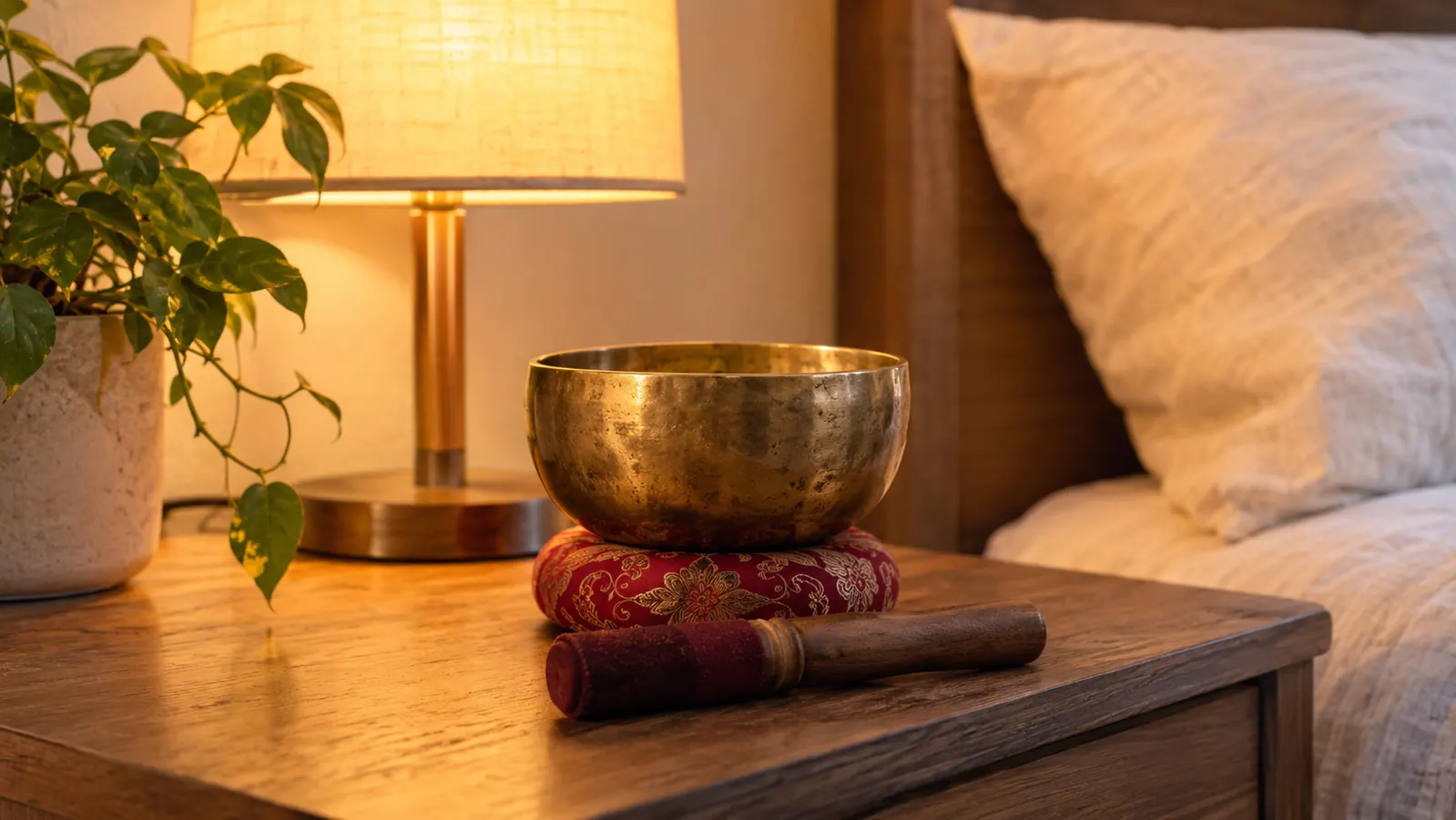
If you want to build a morning routine, put the bowl where you have your coffee. If you want an evening wind-down, put it on the nightstand. The location matters less than the fact that the bowl is already there when the mood strikes. My husband Walt, who claims he's tone deaf, still knows exactly where the bowl lives because he's seen me reach for it every single morning.
Step 2: Start with one clear strike, not a performance
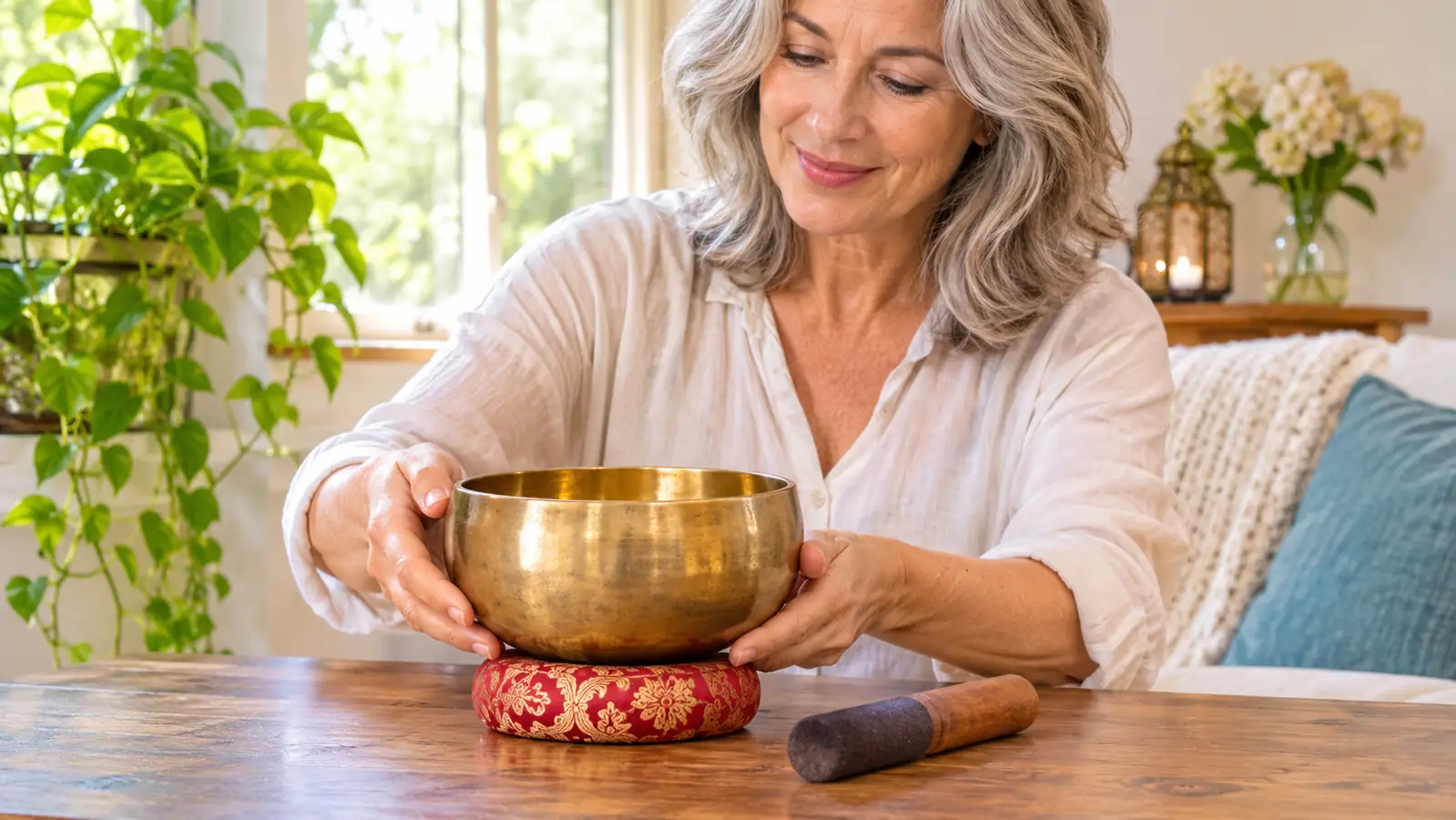
Here's the part that surprises people: you don't need to learn any fancy technique. The Silent Mind bowl is designed for first-time users, and the way to play it is almost embarrassingly simple. Hold the striker loosely in your dominant hand, like you're holding a pencil you're not quite sure about, and tap the outside rim of the bowl once. That's it. One tap. Listen to how long the sound lasts. The first time you do it, you'll probably laugh, because it feels too easy to be the whole technique. That's fine. Laughing is a good way to start a calm routine.
The first time I did this, I expected to have to work at it. I'd watched videos of people circling the rim with the striker, producing that long, rising hum, and I assumed the bowl would only sound right if I did the same. It turns out the bowl produces a clear, resonant tone from a single strike. The listing says the soothing vibrations and resonant tone help create a grounding atmosphere for meditation, breathwork, or quiet moments, and that's been my experience exactly. One strike, and the room changes. The bowl is made from ancient Tibetan metalwork, which is a fancy way of saying it's a real singing bowl, not a decorative trinket. The metal has a weight to it that cheap bowls don't.
Don't worry about whether you're doing it correctly. There's no correct. There's only the sound you make and the way it lands on you. Some mornings I strike the bowl once and let that single tone carry me through a whole ten-minute sit. Some mornings I strike it a few times, spaced out, like a slow heartbeat. Both are right.
Step 3: Let the sound be the timer
A singing bowl is a timer you can feel. When I worked in community mental health, I learned that a lot of people struggle with open-ended meditation because their minds start racing the moment there's nothing to do. A bowl solves that problem without you having to do anything. You strike the bowl, and the sound becomes the container. You're not meditating into empty space. You're sitting inside a tone. I've watched people who could not sit still for thirty seconds hold a tone for minutes at a time. The sound gives the mind something to do.
Here's the routine I actually use, and it's embarrassingly plain. I sit in my chair in the sunroom with my coffee cooling on the table. I strike the bowl once. I breathe in for the length of the tone, and I breathe out for the length of the tone. When the sound fades, I strike it again. That's the whole practice. No app, no timer, no counting. The bowl tells me how long to sit, and I don't have to make any decisions. Some days the coffee gets cold. I don't mind. The point was never the coffee.
The Silent Mind set includes a premium eBook series, a detailed user guide, and a 3D sound bath audio track, so if you want more structure than my plain version, it's in the box. But I'll tell you the same thing I tell everyone who asks: the guide is a nice extra, and the bowl works on its own. Ten minutes of striking the bowl and breathing is a complete routine. Everything else is garnish.
Step 4: Pair the bowl with something you already do
The fastest way to make a routine stick is to attach it to something you already do every day without thinking. For me, that's coffee. I make my coffee, I carry it to the sunroom, I sit down, and I strike the bowl. The coffee and the bowl have become one ritual. I don't have to remember to practice. I just have to make coffee, and the bowl is right there. It sounds too simple to work, and that's exactly why it works. Habits are built on repetition, not on willpower.
For other people, the anchor is different. A friend of mine strikes her bowl the moment she gets into bed, before she picks up a book. Another strikes his after he lets the dog out at night. The anchor doesn't matter. What matters is that you're not trying to add a new habit to an empty schedule. You're stacking the bowl on top of a habit that already exists, which means the routine builds itself.
This is also the step where the gift-ready nature of the Silent Mind set becomes relevant. Because it comes with everything you need in one box, it's an easy thing to give someone who is trying to build a calmer routine. My daughter, who lives out of state, called me one evening after a long day and said she wished she had a way to wind down. I sent her this set. She now strikes the bowl on her nightstand before she reads, and she tells me it's the closest thing she has to my sunroom from three hundred miles away. She's not a meditator and she's never owned an instrument before, which is exactly why I chose this set for her. If she can do it, anyone can.
Step 5: End with a second strike, not a fade-out
How you end the routine matters as much as how you start it. When I first began, I would play for a while and then just stop, and the ending always felt abrupt. Then I learned a simple trick: end the way you started. Strike the bowl once more, and let that final tone be the last thing you hear before you get up. It closes the loop. It tells your nervous system that the quiet time is over and you're returning to the rest of your day. I learned this the way I learn most things, by doing it wrong first and noticing the difference.
The final strike doesn't need to be dramatic. It's just a signal. I do it, I sit for a few more breaths while the tone fades, and then I stand up and take my coffee cup to the kitchen. Walt will tell you he can't hear the difference between one strike and another, but even he has noticed that I'm in a better mood on the mornings I remember to do it.
If you're doing this at night, the final strike is even more useful. It becomes the boundary between your day and your sleep. Strike the bowl, let the tone fade, and let that be the last sound you create before you turn out the light. It's a small thing, but small things are how routines are built. The bowl doesn't care if you play it at six in the morning or eleven at night. It makes the same sound either way, and that consistency is part of the comfort.
What Else Helps
A few things make the routine easier, and none of them cost anything. First, keep the bowl in the same place every day. The bowl on its cushion, the striker beside it, the same chair, the same table. Routine lives in repetition, not in variety. Second, don't judge the sound. Some mornings the bowl will ring like a bell and some mornings it will sound dull, and both are fine. The bowl is a tool, not a performer. Third, if you miss a day, don't turn it into a crisis. Just strike the bowl the next morning and carry on. Guilt is the enemy of any calm practice. One more thing: play for yourself, not for an audience. The moment I stopped trying to make the bowl sound impressive, it started sounding better.
I should also say the thing I said to people for twenty-four years: an instrument like this helps with relaxation and routine, and it doesn't treat anxiety, depression, PTSD, or any condition. If you're struggling with a real mental health concern, please see a licensed professional. The bowl is a lovely companion for a calm morning. It's not a replacement for care. I say this with love, because I spent my career in that world. A bowl is a beautiful tool, and it has limits, and knowing the limits is part of using it well.
One strike, and the room changes. The best part of a singing bowl is that you don't have to learn anything before it starts working.
Start your ten-minute routine tonight
The Silent Mind Tibetan Singing Bowl Set comes with the bowl, the cushion, and the easy-play striker, so you can strike your first tone the moment the box arrives. It's a calm, hands-on instrument for adults who want a quiet ritual at home. No experience needed, just ten minutes and a willingness to sit still.
Amazon Check Today's Price on Amazon →