

A quiet corner does not happen by accident. It starts as an awkward empty space, a chair nobody sits in, a windowsill that collects mail, and it becomes a corner only when you decide what belongs there. I spent twenty-four years in community mental health, most of them in rooms full of stressed people, and I can tell you the same thing happens at home: calm has to be arranged, and it has to be arranged on purpose. The rooms where people settled fastest were never the fanciest ones. They were the ones where someone had made a small decision about where a person should sit and what that person should be able to reach. Ten years before I retired, I started bringing a small hand drum to group sessions, not because I knew how to play it, but because it got people talking.
This is how I arranged mine. The corner is in my sunroom, a narrow room at the back of our two-story house in Albany, and the instrument at the center of it is the Koshi Terra Tuned Wind Chimes. No experience needed. No tuning, no amplifier, no lessons. You hang it, you touch it, and it makes a sound that asks you to slow down. If you have been wanting a calm spot of your own but do not know where to start, this is the step-by-step version of what I did, in the order I did it.
The chime that anchors my quiet corner
The Koshi Terra is a hand-made wind chime from the French Pyrenees, tuned to eight notes and ready to hang in minutes. It weighs 155 grams, which means any hook will hold it. It is the whole instrument my corner needed, and it might be the whole instrument yours needs too.
Amazon Check Today's Price on Amazon →Step 1: Choose the Spot
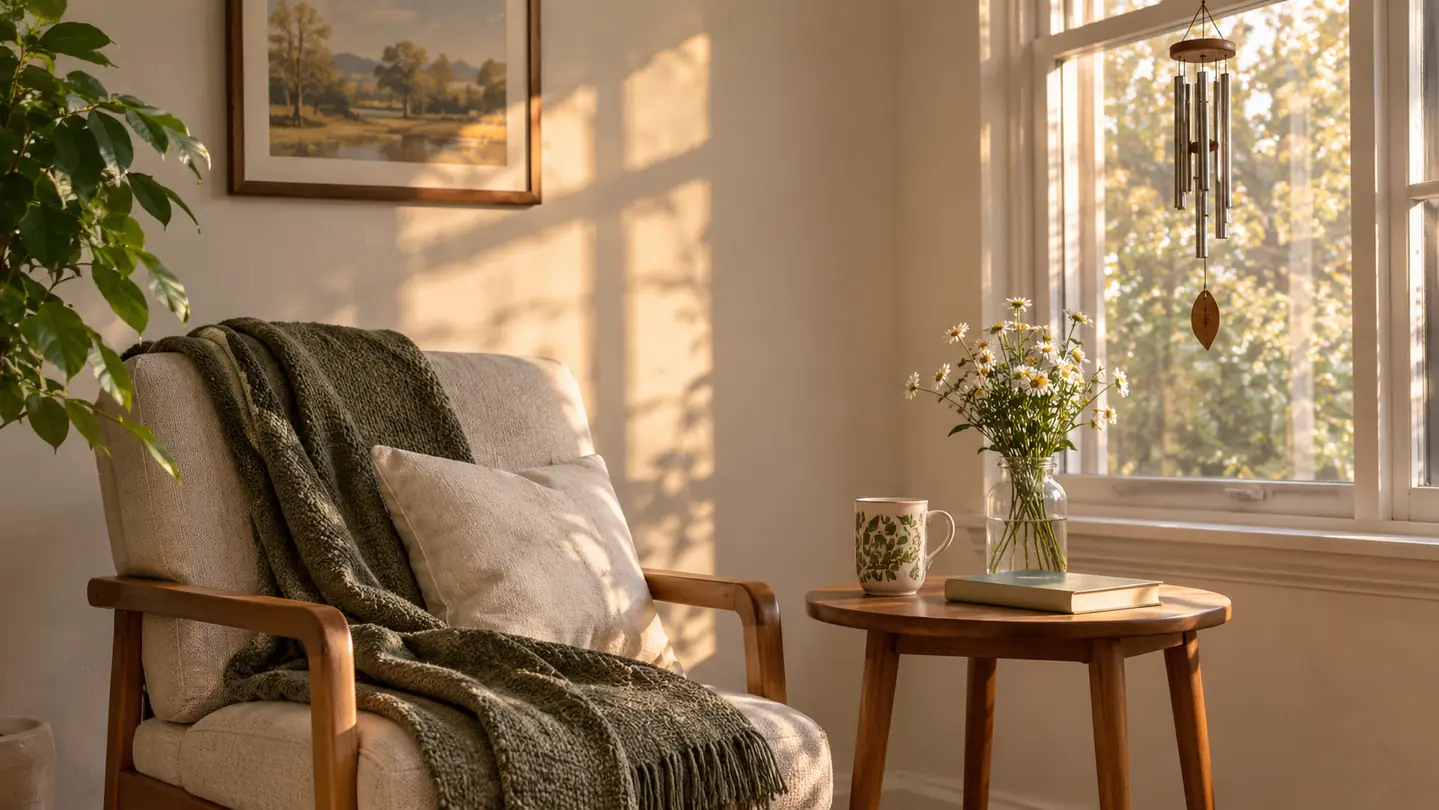
The spot picks itself if you watch where you already sit. For me it was the sunroom. For you it might be the end of the couch, the chair by the bedroom window, or a corner of the dining room that only gets used at holidays. The right place has three things: a seat, a little light, and no reason for anyone else to walk through it. You are not building a meditation studio. You are claiming a two-foot square of floor that already exists.
Light matters more than you think. A window gives you something to look at while you play, and if the window opens, the chime will sometimes play on its own in the breeze. That is not a flaw. That is the instrument doing its job. If your only quiet spot is a hallway or a corner of the bedroom with no window, that still works. The light is a bonus, not a requirement.
Do not put the corner where you can see the television or the kitchen sink. The whole point is a view that does not ask anything of you. A wall, a window, a plant, a curtain moving in the air, that is enough. Before you commit, sit in the spot for five minutes with your eyes closed and listen. If what you hear is traffic and the refrigerator, move the chair three feet and try again.

Step 2: Clear the Space
Once you have the spot, you have to defend it. The quiet corner fails the day the mail lands on the chair. So the rule is simple: one seat, one small flat surface, and nothing that has a job. If it is a bill, a phone charger, or a to-do list, it lives somewhere else. The corner is not a holding area for things that need doing. It is a place where nothing needs doing.
I keep a small table beside the chair with exactly three things on it: a mug, a book, and the chime when it is not hanging. That is the whole inventory. A corner this small does not need decorating. It needs emptying. If the space already has a plant or a lamp, keep them. If it has a stack of old newspapers, move the stack. You will be surprised how much calmer a room feels when one surface is completely clear.
If you live with other people, tell them what the corner is for. My husband Walt, a retired bus mechanic who claims he is tone deaf, knows the sunroom chair is mine. He teases me about it and he also leaves it alone, which is the arrangement working as intended. You do not need a door or a screen. You need an understanding, and most households will give you one if you ask.
Step 3: Set Up the Chimes
The Koshi Terra is genuinely easy to install, which is one of the reasons it ended up in my sunroom. It weighs 155 grams and measures about 6.5 inches long and 2.48 inches across, so any small hook or stand will hold it. I hung mine from a hook at the side of the window, at hand height, so I can reach the glass pendant without getting up. If you have a ceiling hook, that works too. The important part is that you can reach it from your seat.
The chime is handmade in the French Pyrenees, with bronze batons, a glass pendant, and a tube of multi-laminated bamboo veneer with a lacquered finish. You do not need to know any of that to enjoy it, but it explains why the sound is balanced and warm instead of tinny. The materials are the reason. Koshi names this tuning Terra and ties it to the theme of love, which is a roundabout way of saying it sounds gentle rather than bright.
Hang it where the air moves a little but not where the wind will bang it against the wall. A corner near a window that opens a few inches is ideal. The chime is not fragile, but the pendant is glass, so give it a little room. If the only place you have is a door frame, a hook on the frame works fine. The rule is the same everywhere: reachable from your seat, out of the way of traffic.
Step 4: Learn to Play It
Here is the part people worry about, and here is the relief: there is nothing to learn. You do not strike the chime. You touch the glass pendant and let it swing, or you brush the bamboo tube with a fingertip, and the sound follows. The chime is tuned to eight notes, G C E F G C E G, and it arranges them for you. You cannot play a wrong note, because you are not playing notes at all. You are setting the instrument in motion and listening to what it does.
The first few times, I played it the way a child plays with a new toy, curious and a little clumsy. That is the correct way to start. Let the pendant swing and listen to how the notes change with the motion. Fast swings give you a different sound than slow ones, and both are right. Some mornings I play for two minutes and some mornings I play for ten. The chime does not keep score.
You can also simply leave it hanging and let the air play it. Near an open window, the chime will make small sounds on its own, and those small sounds are surprisingly good at pulling a room back to a normal volume. I did not believe this until I heard it happen. There is no switch and no volume control, which sounds like a limitation until you realize the instrument already knows how loud a room needs it to be.
Step 5: Build a Small Routine
A quiet corner becomes a quiet corner through repetition, not decoration. My routine is ten minutes in the morning with coffee and ten minutes at night before bed. That is it. The chime does not need more, and I have found that a short daily touch beats a long session once a month. If ten minutes sounds like a lot, start with one. The goal is that the chair becomes familiar, not that you become skilled.
In the morning, I sit with the mug in one hand and play with the other. In the evening, I play without the coffee, usually while the room goes dark. The routine is the part that makes the corner work, because after a few weeks your body learns what the chair is for. You will sit down and feel yourself exhale before you have even touched the chime. That is the corner working. On busy days, I play for one minute with the window open and count it as done.
Walt says he cannot tell one note from another, and he still asks me to play before bed. That is the whole review of the routine, from a man who claims to be tone deaf. You do not need good ears, good rhythm, or good posture. You need a chair, a hook, and a habit.
What If Your House Is Not Quiet?
Most people tell me they cannot have a quiet corner because their house is too busy. There is always a television, a teenager, a dog, a neighbor with a lawnmower. I understand. Our house is not silent either. Walt watches the news at full volume and the sunroom is ten feet from the kitchen. The corner does not need silence. It needs contrast.
A quiet corner next to a loud house still works, because the corner is not about the room being quiet. It is about you having a place where you decide what happens. The chime will not compete with the television, and it does not need to. You play it when the house is quiet, or you put a pair of inexpensive earplugs in and play it anyway. The routine survives the noise. The chime is not competing with the news. It is giving you something to listen to after the news is over.
If you share a wall with neighbors, hang the chime away from the shared wall and play it gently. The sound is soft by design. A chime that weighs 155 grams is not going to bother anyone on the other side of a wall. The bigger risk is that you will not use the corner because you are waiting for the perfect quiet house. Do not wait. Start in the house you have.
What Else Helps
The chime is the center of the corner, but a few plain things make the corner easier to use. A cushion that fits your back. A mug of something warm. A blanket for cold mornings. Low light in the evening, a lamp instead of the overhead light. And your phone in another room, because a phone is a to-do list with a screen. A small rug under the chair helps too, because it marks the corner as a place rather than a gap in the room. None of these cost much.
If you already own another instrument, a small hand drum or a bowl you like, you can keep it on the table and alternate. I brought a small hand drum home from my years in group work and it sits on the shelf. But do not overcrowd the corner. One instrument at a time keeps the space quiet, which is the entire point. The corner should feel slightly empty. That emptiness is what your brain reads as rest.
One honest note: an instrument is not a treatment. If you are dealing with anxiety, depression, or any real mental health concern, please see a licensed professional. What the chime offers is a routine and a sound that help some people settle. That is enough, and it is also honest. I spent my career referring people to the right kind of help, and this is the same advice I would give a friend.
You will know the corner is working when you catch yourself heading for the chair without deciding to. That happens around the third week for most people. It happened for me, and it surprised me, because I did not think of myself as someone who needed a quiet corner. I thought of myself as someone who made them for other people. It turns out everyone needs one, including the person who hands out the advice.
One hook, one chime that weighs 155 grams, eight notes tuned to G C E F G C E G. That is the whole quiet corner.
Bring the quiet corner home
The Koshi Terra Tuned Wind Chimes is the instrument I reach for every morning and every night. It hangs in minutes, plays without lessons, and sounds balanced and warm. If a quiet corner is what you are after, this is a good place to start. It was mine.
Amazon Check Today's Price on Amazon →