

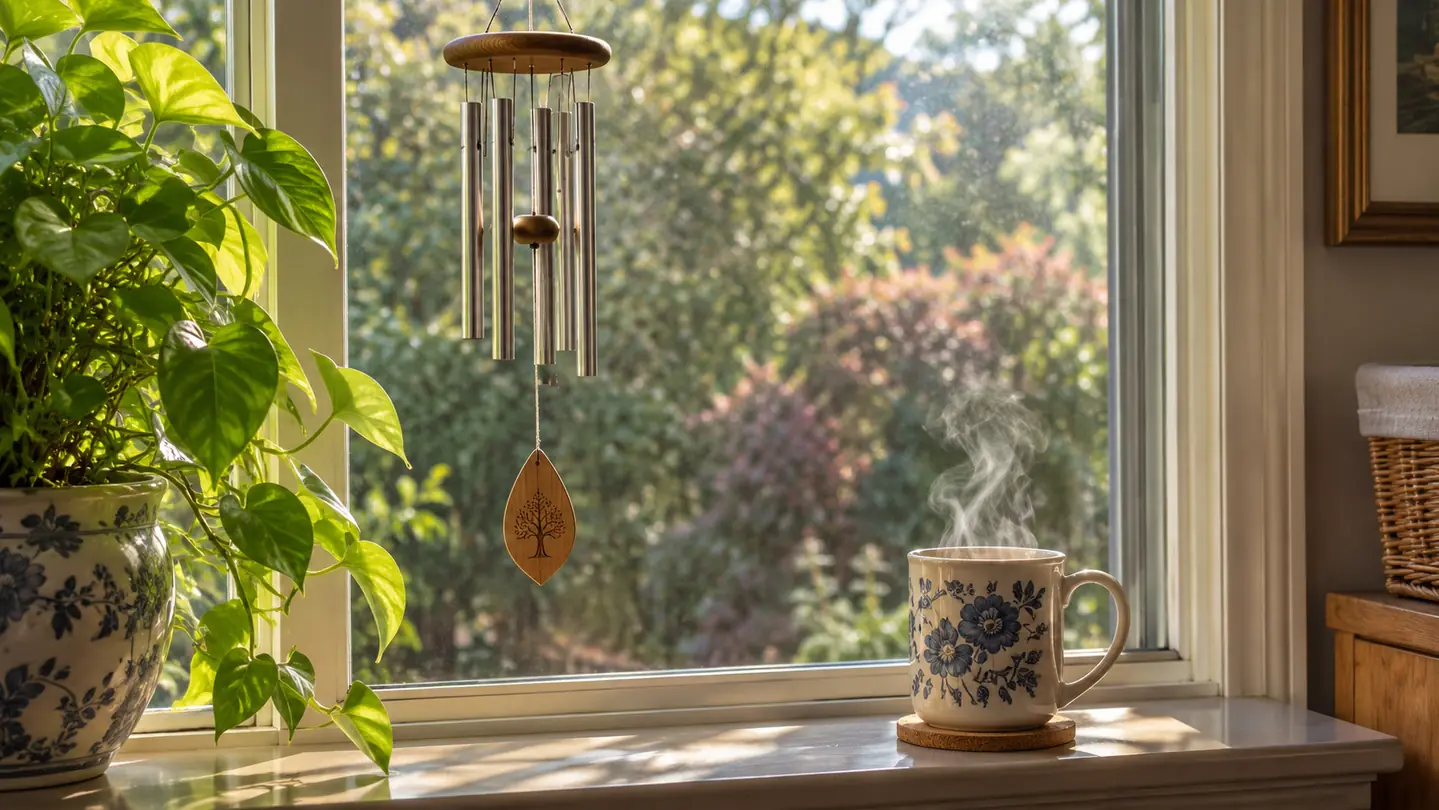
My sunroom has a job. It is the room where Walt and I drink coffee before the day gets loud, and where I spent the last working years of my life unwinding at the end of a shift. About a year ago I decided the room needed a sound. Not music, exactly. A sound. Something that would mark the start of a quiet minute the way a door marks the start of a room. That is how the Koshi Terra chime came to hang in the window frame, and this is what a season of daily listening has actually been like.
I should say what I am not. I am not a musician. I played piano badly as a kid and never made it past the first book. For twenty-four years I worked in community mental health, mostly case management, and about ten years before I retired I started bringing a small hand drum to group sessions because it got people talking. I have seen what a calm sound does to a room full of stressed people. I also know I am not a licensed music therapist, and I am not going to tell you a wind chime treats anxiety or anything else. It does not. What it does is give you a small, repeatable ritual and a sound that makes your shoulders drop. After a season of using the Koshi every day, I think that is worth a great deal.
The Quick Verdict
A beautifully made, genuinely calming instrument that earns its place in a daily routine. The sound is warm and balanced, the build is lovely, and after months of daily use it still makes me stop and breathe.
Amazon Check Today's Price →The chime that starts my quiet minute every morning
If you want a calm, hands-on sound for a corner of your home, the Koshi Terra is the one I reach for. Hand-made in the French Pyrenees, tuned to a warm G C E F G C E G scale, and light enough to hang anywhere.
Amazon Check Today's Price on Amazon →How I've Used It
My routine is not impressive. Most mornings I pour coffee, open the sunroom door, and give the chime a gentle push as I sit down. The batons swing, the glass pendant follows, and for the next ten minutes the room has a soft, layered sound underneath the quiet. I do the same thing at night before bed. That is the whole ritual. It takes about three seconds to start and it has been the most reliable part of my day for months.
At night it is even simpler. I give the chime one push, climb into bed with a book, and let the last notes fade while I find my place. I have come to think of that fading sound as the day officially ending. It is a small thing, but small things are what a routine is made of.
The Koshi is easy to live with. It weighs 155 grams, which is light enough that I hung it from a small hook in the window frame without a drill or a stud finder. The specs call it easy to install, and for once that is accurate. It is 6.5 inches long and 2.48 inches wide, so it fits in a window, over a door, or on a stand if you prefer. I have moved it twice, once to a different window when the light changed, and it took me longer to find the new hook than to hang it.
You play it the way you would expect: you set the batons moving and let the chime do the rest. There is no technique to learn and no way to play it wrong, which is the whole reason it works for someone like me. I have watched people who insist they are not musical push those batons and then go quiet for a minute, listening. That minute is the product. The chime is just the delivery system.

What the Terra Tuning Actually Sounds Like
The Terra is tuned to G C E F G C E G, and that tuning is the reason it never sounds like a mistake. I did not know that when I bought it. I only knew the sound was warm and balanced, which is how the maker describes it and how I would describe it too. The notes overlap and decay slowly, so you get a soft wash of sound rather than a single plink. It is the difference between someone tapping a glass and someone ringing a bell that keeps ringing.
Because the scale is fixed and pleasant, you cannot play a wrong note. That matters more than you might think for adults who have spent their whole lives being told they are not musical. I have had friends stand in my sunroom, push the batons, and then look surprised at themselves for lingering. Nobody has ever pushed it and handed it back quickly. The sound invites you to stay in it.
The other tunings from the same maker are named aqua, aria, and ignis, and I have heard all three. Terra is the one I kept, because it is the warmest to my ear and the most neutral for a room I use for both morning coffee and evening quiet. If you want brighter or more airy, one of the others may suit you better. The chime itself is the same; the tuning is the personality.
Build Quality and Where It Is Made
The Koshi is hand-made in the French Pyrenees, and you can feel that in the details. The tube is a multi-laminated bamboo veneer, which means it is built up in layers rather than cut from a single piece. The batons are bronze. The pendant is glass. Everything has a lacquered finish that has held up well to a year of daily handling and the occasional bump from my coffee mug when I reach across the sill.
The dimensions are small enough to be unobtrusive: 6.5 inches long, 2.48 inches wide, 2.48 inches deep. At 155 grams it has a solid, substantial feel without being heavy. Nothing has loosened, nothing has rattled, and the sound has not changed in a way I can detect. I cannot promise it will last forever, but I can say that after a season of daily use it looks and sounds the way it did on day one.
One honest note: the glass pendant is the delicate part. I keep the chime away from doorways and drafts, and I do not let it swing hard. It is not fragile in the sense that it will break if you look at it. It is fragile in the sense that it is glass, and glass is glass. Treat it like a nice thing and it will behave like a nice thing.
What a Season of Daily Listening Taught Me
The biggest surprise is that the chime did not change my life. It changed my minute. The instrument itself is simple, and the benefit comes from the routine around it. When I push those batons, my brain gets a small cue that the next ten minutes are for sitting still. That cue has worked almost every single day for a year, which is more than I can say for any other habit I have tried to build.
Walt claims he is tone deaf, and I have learned not to argue with him. But even he has stopped mid-morning to say the room sounds different when the chime has been played. He will not admit to liking it. He just stands in the doorway a beat longer than he used to, and that is the same thing in a man who has spent his life fixing buses and calling music 'noise.' I will take it.
I want to be careful here, because I spent my career around people who genuinely needed help, and I would never want anyone to mistake a wind chime for treatment. It is not. If you are dealing with real anxiety, depression, or anything that is weighing on you, please talk to a licensed professional. What the Koshi offers is a pause, not a cure. A pause is still valuable. A pause is how you get from a loud day to a quieter one.
The other thing I learned is that the novelty does wear off, and that is fine. In the first week I found myself pushing the batons every time I walked past. By the third month I only played it during my two daily sits. That is not a flaw. That is the instrument settling into the background of your life, which is exactly where a calm sound belongs. It is there when you want it and quiet when you do not.
How It Compares to What I Almost Bought
Before I settled on the Koshi, I almost bought a set of long bamboo wind chimes for the porch. They are beautiful and they cost less, but they need wind, and wind does not show up on schedule. The Koshi does not need wind. It needs a hand, which means it works at 6:40 in the morning when I want it and not a minute before.
I also tried the obvious free option, which is a meditation app on my phone. The app worked for about a week, and then my phone turned back into the thing that buzzes at me. There is something about a physical object that a screen cannot replace. You have to get up, walk to it, and touch it. That small physical effort is the ritual. The chime is the reward at the end of the motion.
For a similar price you can get a singing bowl, and I have spent enough time around them to know they are lovely. But a bowl asks you to learn a little technique, and a chime asks nothing. On days when I am tired, the chime wins. On days when I want something more involved, the bowl comes out. They are different tools for different moods, and the Koshi is the one that gets used daily.
What I Liked
- Warm, balanced sound that is genuinely calming
- Hand-made in the French Pyrenees with quality materials
- Lightweight at 155 grams and genuinely easy to install
- Tuned scale means it sounds pleasant no matter how you play it
- Small enough at 6.5 inches to hang almost anywhere
Where It Falls Short
- It is a hand-played instrument, so it will not sing on its own in the breeze
- The glass pendant is delicate and needs a spot away from doorways and drafts
- The sound is subtle, not loud; a big room will swallow it
- The benefit lives in the routine, so if you do not use it, it is just a pretty object
The chime does not fix anything. It just makes the next ten minutes quieter, and after a season of daily use I have decided that is exactly the point.
Who This Is For
Buy the Koshi Terra if you want a small, beautiful object that gives you a reason to sit still for ten minutes. It is for people who like ritual, who drink coffee slowly, who have a windowsill that needs something alive in it. It is for adults who think they are not musical and would like to be proven gently wrong. It is for anyone who has tried to build a calming habit and found that apps and timers do not stick. A physical chime in your actual room is harder to ignore than a notification.
If you are the kind of person who has a favorite mug, a favorite chair, and a particular way you like the morning to start, you already understand what this chime is for. It is the sound version of a favorite mug.
Who Should Skip It
Skip it if you want a wind chime that plays itself. The Koshi needs a hand, and if you hang it outside hoping the breeze will do the work, you will be disappointed. Skip it if you want loud, dramatic sound; this is a quiet instrument for a quiet room, and in a big open space it will get lost. And if you are hoping a chime will treat a real mental health condition, this is not that, and no honest review should let you believe it is. See a licensed professional for that. Come back to the chime for the pause afterward.
One more thing: if you live with small children or in a house where things get knocked around, you may want to wait until the house is calmer. The Koshi is a lovely object, but it is not a toy, and the glass pendant is the reason.
Six months in, it still starts my quiet minute
The Koshi Terra is the rare instrument that asks nothing of you and gives you a small, warm moment every time. If that sounds like your kind of morning, it is worth a look.
Amazon Check Today's Price on Amazon →