
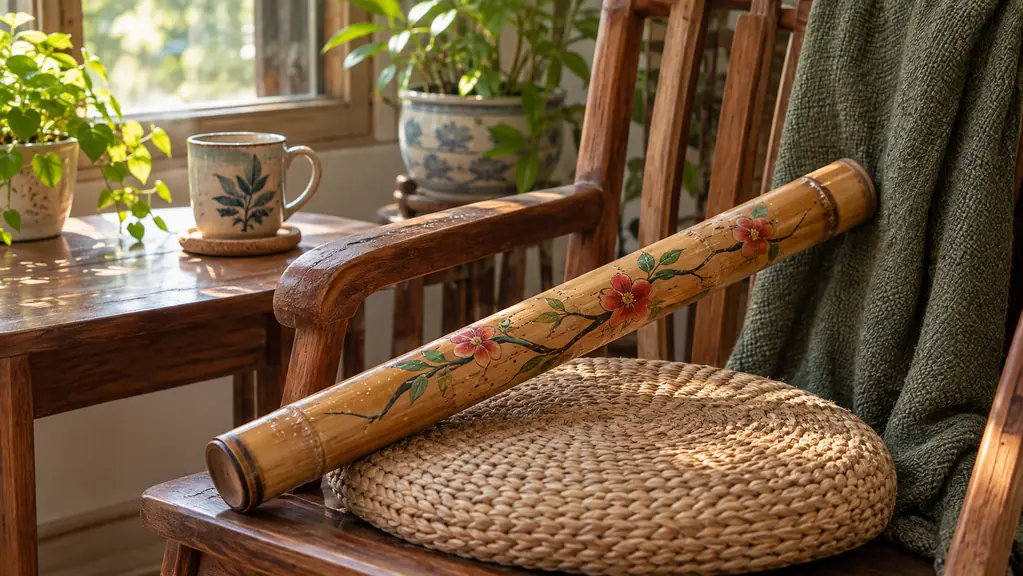
Some evenings I come in from the garden, sit down in the sunroom, and realize my shoulders are still up around my ears. I do not need a lecture about breathing. I need something to do with my hands that sounds like water. That is why I keep a Meinl Percussion 16-inch bamboo rain stick on the little table by my chair. It is the simplest instrument I own, and it is the one I reach for most often when I want to slow down.
I spent twenty-four years in community mental health, mostly case management, and I am not a music therapist and never claimed to be. What I noticed, over and over, is that a person who is wound tight will often settle faster when there is something simple to hold and listen to than when someone tells them to calm down. A rain stick does that without asking anything of you. You do not need to read music. You do not need a lesson. You tilt it, it sounds like rain, and your breathing tends to follow.
The 16-inch bamboo rain stick I keep by my chair
Meinl Percussion makes a small rain stick that is 16 inches long, weighs about 1.1 pounds, and sounds like a small stream with the gentlest tilt. If you want a calm, hands-on instrument for home, this is the one I would start with.
Amazon Check Today's Price on Amazon →Why a Rain Stick Works for Relaxation
A rain stick is a tube of bamboo with something loose inside that falls through a spiral and lands like water. Meinl Percussion builds theirs with a 100 percent bamboo shell, and the internal filling is shaped to produce a trickling water sound. You can hear it clearly in a quiet room. There is no volume knob and nothing to learn. The instrument is the whole thing, and that is exactly what makes it relaxing.
The sound profile is described as natural and warm tones. In practice that means it does not ping or rattle. It sounds like a small stream running over stones, which is a sound most of us associate with being outside and unhurried. The first time Walt heard it he said it sounded like a leaky gutter, which is exactly the kind of thing he would say. He claims he is tone deaf, and he is not wrong about the gutter, but he has stopped complaining, and sometimes he sits and listens anyway.

What You Need Before You Start
Three things: the stick, a quiet place, and about five minutes. That is the whole list. There is nothing to assemble, nothing to plug in, and no connector to worry about. You take the stick out, sit down, and it is ready to play. The Meinl Percussion rain stick is a single 16-inch piece of bamboo, so the setup is the same every time: none.
You do not need a stand, a case, or any special surface. A table, a lap, or the arm of a chair all work. The specs list the stick at 16.14 inches long and 2.17 inches wide, which is small enough to keep on an end table and light enough at 1.1 pounds to hold for a full ten minutes. I keep mine on a little table in the sunroom, next to my coffee mug.
Step 1: Find a Quiet Spot and Get Comfortable
You do not need a special room. I use the sunroom at the back of the house because it is quiet and the light is soft in the morning, but a kitchen chair at an empty table works just as well. The point is to pick a place where you will not be interrupted for five minutes and where you can actually hear the sound. A rain stick is not loud. It is meant to be listened to close up.
Sit down, put your feet flat on the floor, and let your hands rest in your lap. You can keep your eyes open or close them, whatever feels natural. I usually keep mine open for the first minute and then let them close on their own. The stick can rest across your knees or on the arm of the chair. It is 16 inches long and weighs about 1.1 pounds, so it is easy to hold, but you do not need to hold it the whole time.
If you feel a little silly doing this, that is normal. I felt silly the first time I tried one, and I had been bringing a small hand drum to group sessions for years before that. Give yourself permission to look foolish for five minutes. Nobody is watching. The worst thing that can happen is that you make the sound of rain in your own living room, and the best thing is that your shoulders come down.
Step 2: Hold the Stick at a Gentle Angle
Pick the stick up with both hands, one near the top and one near the bottom, and tip it so it sits at a gentle angle, maybe thirty degrees from flat. You do not need to be precise. Meinl Percussion designed this rain stick so the internal filling moves as you tilt it, and the sound starts as soon as the angle changes. The gentler the angle, the softer the rain.
Hold it loosely. A death grip tenses your shoulders, which is the opposite of what we are after. Let the weight of the bamboo do the work. At 1.1 pounds it has enough heft to feel solid without feeling heavy, and the 16-inch length means it balances nicely across your lap. I like to rest the bottom end on my thigh so my arms can relax.
Listen for the first few seconds without trying to make the sound do anything. The filling falls through the spiral and lands like water. The sound profile is natural and warm, so what you hear is a soft trickle, not a rattle. If you hear a rattle, you are probably tilting too fast. Slow down and let the stick do its job.
Step 3: Start with Small Tilts
The whole trick to a rain stick is that you control the sound with the angle. A small tilt gives you a light trickle, like rain beginning on a window. Tip it a little further and the sound gets fuller. The Meinl Percussion listing describes it this way: gently angle the stick to sound like a small stream, and tip it all the way for a rushing monsoon effect.
Start small. Tilt the stick just a few degrees, let the filling fall, then bring it back level and let the sound stop. Then do it again. What you are doing is teaching your hands how much movement makes how much sound. It takes about two minutes to get the feel of it, and there is no wrong way to hold it or tilt it. The only mistake is rushing.
When you tip it all the way, the sound is bigger and faster, like a downpour. That is fun, and I do it sometimes just to hear it. But for relaxation, the small stream sound is usually the one that works. It is easier to breathe with a trickle than with a monsoon, and the small tilts are easier to repeat without thinking.
Step 4: Match the Sound to Your Breathing
Here is the part that turns a pleasant noise into something that actually settles you down. Tilt the stick as you breathe in, and let the sound run as you breathe out. The trickle lasts about as long as a slow exhale, which is a handy coincidence. Your breath sets the pace, and the rain follows. You do not need to count or keep time.
I do this for a few minutes most mornings with my coffee. Inhale, tilt, exhale, let the sound finish, rest for a beat, and start again. The sound tells you when to breathe, which is easier than trying to remember to breathe. After a few rounds, I notice my jaw unclenches and my hands stop gripping the stick.
If your mind wanders, and it will, just bring it back to the sound. That is the whole exercise. There is no achievement in it. You are not trying to get anywhere. You are just sitting in a room, making the sound of a small stream, and letting your breathing find its own pace. Some days it works in two minutes. Some days it takes the whole ten.
Step 5: Build a Simple Routine
The relaxation part comes from repetition, not from any single session. I play for about ten minutes most mornings with coffee and again at night before bed. That is it. Ten minutes is enough to make the routine feel real and short enough that I never talk myself out of it. The rain stick lives on the table by my chair, so it is always in sight.
Keep the stick somewhere you can see it. If it is tucked in a closet, you will not use it. If it is out, you will pick it up without thinking, and that is the whole point. I keep mine next to my coffee mug in the sunroom, and most mornings I do not decide to play it. I just reach for it while the coffee brews.
You can also use it in small moments, not just in a routine. When I am waiting for water to boil or when I sit down after a long phone call, I give the stick one slow tilt, just to reset. One tilt takes about three seconds. It is amazing how often three seconds of rain is enough to drop my shoulders back where they belong.

A Few Things I Learned the Hard Way
The first time I bought a rain stick, I tipped it too fast and got a sound like a handful of gravel. I almost put it away. Then I slowed down, and the same stick sounded like a stream. The lesson is that the instrument is patient but you have to meet it halfway. Small movements, soft hands, and a quiet room will do more than any technique.
The other thing I learned is that the hand painted finish matters more than I expected. It makes the stick feel handcrafted rather than factory-made, and bamboo has a natural warmth to it that plastic never quite matches. The finish type is hand painted, and the shell is 100 percent bamboo. It is a small thing, but it is part of why this stick is pleasant to hold for ten minutes at a time.
What Else Helps
A rain stick is a tool for relaxation, not a treatment for anything. I want to be plain about that. Instruments help with relaxation and routine, but they do not treat anxiety, depression, PTSD, dementia, or any condition. If you are struggling with a real mental health concern, please see a licensed professional. That advice matters more than anything I can tell you about this stick.
That said, a few small things make the routine stick. Pair the rain stick with something you already do, like morning coffee. Keep the room quiet. Put your phone face down. And if you want a second sound to alternate with, a small ocean drum is a nice companion because it gives you a different texture, but you do not need one to start. One instrument, used regularly, is worth more than three used occasionally.
You will also get more from the stick if you stop judging the sound. Some days it will sound like a perfect stream. Other days it will sound like someone shaking a bag of rice. Both days count. The point is not a perfect rain sound. The point is that you sat down, picked something up, and gave yourself five minutes of quiet. That is the whole win.
One slow tilt takes about three seconds, and it is amazing how often three seconds of rain is enough to drop my shoulders back where they belong.
Start with the small one, the 16-inch
The Meinl Percussion 16-inch bamboo rain stick is the small model, and small is right for a first instrument. It weighs about 1.1 pounds, sounds like a small stream with a gentle tilt, and fits on an end table. If you want a calm, hands-on way to slow down at home, this is where I would start.
Amazon Check Today's Price on Amazon →